
Why a Scent Opens a Door: Olfaction, Emotion and Memory
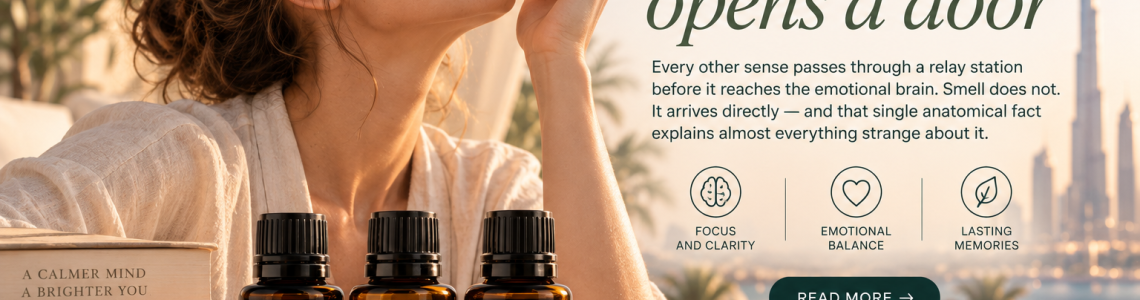
Why a scent
opens a door
Every other sense passes through a relay station before it reaches the emotional brain. Smell does not. It arrives directly — and that single anatomical fact explains almost everything strange about it.
You walk past someone on a street and a smell arrives, and before you have identified what it was you are eight years old, in a particular room, with a particular light coming through a particular window. The whole thing lasts perhaps two seconds. It is not like remembering. You did not decide to do it, you could not have produced that memory on request an hour earlier, and now that it has gone you probably cannot get it back on purpose.
Almost everyone has had this happen, and almost everyone treats it as a curiosity. It is not. It is the visible consequence of a genuinely unusual piece of wiring — smell is the only one of the senses that reaches the parts of the brain responsible for emotion and memory without first passing through the thalamus, the relay station that filters and routes everything else. Sight, sound and touch all report there first. Smell takes a shortcut that no other sense has.
The anatomy is the whole explanation. A shorter path to the amygdala and the hippocampus means odour-evoked memories arrive faster, feel more emotional, and are far less edited than the ones we retrieve deliberately.
myTERRAThis guide sets out that anatomy plainly, then does something more practical with it. If a scent can retrieve a memory involuntarily, it can also be attached to one deliberately — and that is the basis of a genuine, well-documented technique. You can build a scent anchor for focused work, for the transition out of a working day, for sleep, or for a family that has moved countries and wants somewhere to feel like home. Three doTERRA products are used here because each suits a different kind of anchor: Balance for grounding, Wild Orange for lift, Frankincense for stillness.
Six facts that explain everything odd about smell
None of this is speculative. It is standard neuroanatomy, and it accounts for effects that otherwise look mystical.
Vision, hearing and touch all send their signals to the thalamus first, where they are sorted, filtered and forwarded onwards. It is a routing centre, and it introduces a step between sensation and reaction. Olfactory neurons in the roof of the nasal cavity instead project to the olfactory bulb, which connects onward to the piriform cortex, the amygdala and the entorhinal cortex — the gateway to the hippocampus — without that relay. Smell is, in a literal anatomical sense, closer to the emotional and memory systems than anything else you perceive. Everything else in this article follows from that one fact.
The amygdala is central to assigning emotional weight to experience, and it sits unusually close to the olfactory pathway — a very short chain of connections rather than the longer routes taken by other senses. This is why the emotional colour of a smell often arrives before the identification does: you feel something about an odour a moment before you can name it. It also explains the asymmetry in language. People struggle to describe smells, because the pathway favours emotional and mnemonic processing over the verbal machinery that handles what we see and hear so fluently.
Humans carry a few hundred functional olfactory receptor types — far fewer than the number of odours we can distinguish. The system solves this the way an alphabet solves language: each odour molecule activates a particular combination of receptors, and the brain reads the pattern rather than a single dedicated signal. A blend of several oils is therefore not a mixture of separate messages but a new pattern in its own right, which is part of why a well-constructed blend can be recognisable and memorable in a way that a single molecule often is not.
Ask someone to recall a memory prompted by a word or a photograph and the memories tend to cluster in adolescence and early adulthood. Ask for one prompted by a smell and the cluster shifts markedly earlier, into the first decade of life. The likely reason is simply that odour memories are rarely rehearsed. A story you have told many times gets smoothed, edited and consolidated with each retelling. A smell you have not encountered since you were seven has been rehearsed exactly never, and arrives closer to its original form — which is why it feels less like recollection and more like return.
Olfactory receptors adapt quickly. Within minutes of continuous exposure the perceived intensity of a smell drops sharply, even though the molecules are still arriving. This is efficient: the system is built to detect change, not to report a constant background. It has two practical consequences. First, you are the only person who cannot smell your own house, your own perfume or your own diffuser after the first few minutes. Second, intermittent exposure is more effective than continuous — a diffuser running in intervals delivers a stronger perceived signal than one running flat out for hours.
Memory retrieval works better when the conditions at recall resemble the conditions at encoding — a well-established principle, and the reason revising in the room where you will sit the exam is genuinely useful advice. Odour is an unusually effective context cue, because it is distinctive, it is not competing with the verbal content being learned, and it is easy to reproduce exactly. That turns the Proust effect from something that happens to you into something you can set up on purpose, which is what the second half of this guide is about.
Why an odour memory does not feel like an ordinary one
People describe smell-triggered memories in a consistent way across cultures and languages: more emotional, older, more vivid, more sudden. Those four descriptions are not vague impressions — each maps onto a specific consequence of the anatomy above.
Understanding which is which matters practically, because it tells you what a scent anchor can realistically do and what it cannot.
Emotional weight is assigned before, or alongside, identification rather than after it. This is why an odour memory arrives already carrying its feeling, while a photograph tends to deliver the content first and the emotion a beat later, if at all.
Memories retrieved often get consolidated and quietly edited each time. Odour cues reach material that has sat untouched for decades, which is why the memories tend to come from much earlier in life than those prompted by words or images.
Deliberate recall is effortful: you search, narrow, reconstruct. Odour-evoked recall skips the search entirely and delivers the result. That is what makes it feel like something happening to you rather than something you are doing.
Most people can name only a handful of smells confidently and fall back on comparisons for the rest. The pathway favours emotion and memory over verbal labelling — which is a limitation for conversation and, oddly, an advantage for anchoring: the cue does not interfere with words.
Six ways to put a scent anchor to work
thalamic relays between the olfactory bulb and the emotional and memory structures it projects to. Every other sense passes through the thalamus first; smell alone does not.
Reference: standard neuroanatomy of the olfactory pathwayfunctional olfactory receptor types in humans — far fewer than the number of odours we distinguish, because identification depends on the combination activated rather than on one receptor per smell.
Reference: olfactory receptor genetics, commonly cited rangewhere odour-evoked autobiographical memories tend to cluster, markedly earlier than those prompted by words or images — most plausibly because they are so rarely rehearsed.
Reference: autobiographical memory research, general findingsFigures given for orientation, as general reference points rather than clinical measurements. Every body responds differently — consult a qualified professional for individual guidance.
TERRA
WI
A scent anchor works best when it is attached to the transition that actually matters for you — settling at night, separating work from home, steadying a difficult hour. The myTERRA Wellness Index scores five pillars and shows where the load sits, which is usually a better guide to what to build than a general list.
Balance, Wild Orange and Frankincense — grounding, lift and stillness
An anchor works by being consistent and distinctive. These three are chosen because they are unmistakable, they suit three different purposes, and none of them is likely to be encountered accidentally elsewhere in your day — which is exactly what a cue needs.
Balance
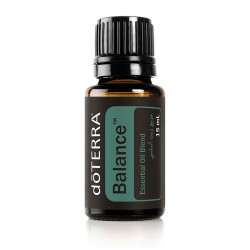
Grounding blend — 15ml · Spruce, ho wood, frankincense, blue tansy, blue chamomile, osmanthusBalance is the most useful of the three for anchoring, and the reason is structural rather than romantic. It is a blend of six materials — spruce needle and ho wood at the base, frankincense giving it a resinous spine, blue tansy and blue chamomile adding their distinctive depth, osmanthus lifting the top — and a blend of that complexity produces a receptor activation pattern that is essentially unique. You will not encounter it by accident in a lift, a taxi or a supermarket, which is exactly what a cue requires. A scent used as an anchor has to be reserved; one you meet twenty times a day cannot mark anything. Its character is grounding rather than sedating: it does not make you sleepy, which means it can be used at four in the afternoon or before a difficult conversation without cost. That makes it the natural choice for transitions — the end of a working day in a home where the office is a corner of the living room, the first ten minutes in a hotel room in an unfamiliar city, the moment before something you are dreading. Used consistently in only those situations for a few weeks, it stops being a pleasant smell and becomes a signal. That transition, from scent to signal, is the entire mechanism, and it is available to anyone willing to be consistent for a month.
- ◆End of the working day: one application at the same moment, every day
- ◆Travel: the same oil in hotel rooms, carrying context into unfamiliar places
- ◆On the wrists or the back of the neck before something demanding
- ◆Reserve it — an anchor used casually stops being an anchor
- ◆Give it three to four weeks of consistency before judging it
Wild Orange
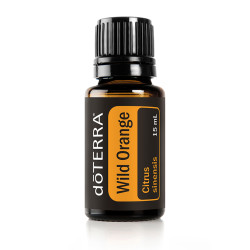
Citrus sinensis — 15ml · Cold pressed from the peelWhere Balance marks an ending, Wild Orange marks a beginning. Cold pressed from the peel rather than distilled, it keeps the bright, direct character of fresh fruit, and its dominant constituent — limonene, which typically makes up the great majority of the oil — has a documented association with elevated mood and reduced subjective stress on inhalation. Citrus oils as a class are among the most consistently studied aromatics for exactly that effect. For anchoring, it has two practical advantages that are easy to underrate. First, almost nobody dislikes it, which matters enormously in a shared office or a family home: an oil someone objects to is an oil that stops being used, and an anchor that stops being used is nothing at all. Second, it is bright rather than heavy, so it suits the start of a task rather than the end of one — a study session, focused work, the first hour of the morning. There is one caution and it is genuinely important in this climate: cold-pressed citrus oils carry phototoxic compounds from the peel, so skin treated with Wild Orange should stay out of direct sun for twelve hours. In practice, diffuse it rather than wearing it if you are heading outdoors.
- ◆Start of a focused session — diffused only while working, never idly
- ◆Study anchor: same oil while learning, same oil while reviewing
- ◆Shared spaces, where a heavier aromatic would be intrusive
- ◆As the scent identity of a family home, used consistently over years
- ◆Phototoxic on skin: no direct sun for twelve hours after application
Frankincense
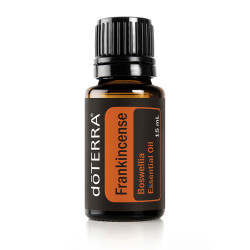
Boswellia carterii, frereana, papyrifera & sacra — 15ml · Steam distilledFrankincense belongs in an article about scent and memory for a reason that predates every study cited here. For three thousand years, across a remarkable number of unrelated traditions, this particular resin has been burned to mark that a space or a moment is set apart from ordinary time. Contemplative practice, ceremony, the transition from public to private. That is, in the language of the rest of this guide, a scent anchor — one built collectively, maintained across generations, and still in daily use in Gulf homes where luban burns in the evening as a matter of routine rather than ritual revival. Modern chemistry does not diminish that; it just adds detail. The distilled oil is dominated by α-pinene, alongside limonene, α-thujene and sabinene — a monoterpene profile with documented anti-inflammatory activity and an influence on airway tone, and one that people consistently describe in terms of clarity and settling rather than sedation. Worth stating plainly, since it is widely repeated otherwise: the boswellic acids that dominate the Boswellia research literature are large, non-volatile molecules that remain in the resin and do not carry over into steam-distilled oil. The oil has its own real constituents and does not need to borrow the resin's evidence. As an anchor, it is the natural choice for stillness — the end of the evening, reading, prayer, or the last twenty minutes before sleep, particularly for anyone who wants a cue that already carries three millennia of the same meaning.
- ◆The last part of the evening — reading, reflection, quiet
- ◆Diffused for 30 minutes before sleep, with Lavender underneath
- ◆One drop in the palms, inhaled slowly, before something that needs stillness
- ◆Culturally continuous here — the same resin, a different delivery
- ◆Store cool and dark; monoterpenes degrade fastest of all fractions
Use with care: Balance comes ready diluted in fractionated coconut oil and is generally well tolerated on skin. Wild Orange is phototoxic when applied to skin — avoid direct sun for twelve hours after use, which matters in this climate. Frankincense should be diluted for skin application and is better used in the evening than immediately before sun exposure. Dilute undiluted oils in Fractionated Coconut Oil and patch test on the inner forearm before first facial use. Diffuse intermittently rather than continuously — receptors adapt within minutes, so intervals deliver a stronger perceived signal than a diffuser running for hours. Ventilate the room, and start with short runs at low output if anyone present has asthma or is a young child. Anyone who is pregnant, breastfeeding, or managing a diagnosed condition should speak to their doctor before regular use.
Four anchors worth having, and how to set each up
Set-up: choose one oil — Wild Orange is the easiest to live with in a shared space — and diffuse it only during focused sessions. Never while scrolling, never in the background, never idly. The exclusivity is the whole mechanism. Why it works: partly context-dependent retrieval, partly the plain behavioural effect of a consistent starting cue, which shortens the gap between sitting down and actually beginning. Students: use the same oil while learning and while reviewing — matching the conditions at encoding and retrieval is a well-supported principle. Timescale: two to three weeks before it starts to feel automatic.
The problem it solves: when the office is a corner of the living room, there is no commute to mark the end of the day, and the working state simply continues into the evening. Set-up: Balance, applied to the wrists or diffused, at the same moment every evening — laptop closed, oil applied, day over. Why Balance: grounding rather than sedating, so it costs nothing at six in the evening, and complex enough that you will not meet it accidentally. The rule: the anchor is the boundary. If you reopen the laptop after it, the cue quietly stops meaning anything.
The problem: an unfamiliar room is unfamiliar in every sensory channel at once, and the first night in a new place is reliably the worst. Set-up: use the same oil at home every night for a few weeks first, so it means something — then bring it. A few drops on a tissue by the pillow, or a travel diffuser, reproduces one strong channel of home in a room where every other channel is wrong. Which oil: Balance or Frankincense; something you have already used consistently, not something new bought for the trip. A note on families: this works particularly well for children, whose sleep is often more context-sensitive than adults'.
The idea: if odour memories cluster in the first decade of life and resist being overwritten, then the smell of a home during a childhood is one of the more durable things a family can create — and it is created by accident in most houses. Choosing it deliberately costs nothing. Set-up: one blend, used consistently in the main living space over years rather than weeks. Wild Orange with a little Balance is a good, uncontroversial starting point. Why it matters here: a great many families in this region have moved from somewhere else, and children who grow up between countries have fewer fixed sensory reference points than most. This is one you can give them on purpose.
Five things that decide whether an anchor holds
-
01One oil, one meaning
The most common mistake is using a favourite oil everywhere — in the car, at the desk, in the bedroom, while cooking — and then wondering why it does not signal anything. A cue works by exclusivity. If a scent is present in every context, it is associated with all of them and therefore with none. Choose one oil for one purpose and be disciplined about it. Keep a separate oil for general pleasure; there is no rule against enjoying a smell simply because you enjoy it, and no reason for that oil to be the anchor.
-
02Diffuse in intervals, not continuously
Olfactory receptors adapt within minutes of steady exposure, so a diffuser running flat out for three hours delivers a strong scent to anyone entering the room and almost nothing to you. Intermittent mode — a few minutes on, twenty or thirty off — maintains a perceptible signal, uses far less oil, and avoids saturating a space. This single adjustment usually improves the experience more than changing the oil does, and it is the most common thing people get wrong with a diffuser.
-
03Give it three to four weeks
An association is built by repetition, and a handful of uses does not make one. The first fortnight usually feels like nothing is happening, because nothing much is — the pairing is still forming. Somewhere in the third or fourth week most people notice that the smell has started to arrive with the state attached rather than merely preceding it. Judging the technique after five days is judging it before it exists, and that is why most people who try scent anchoring conclude it does not work.
-
04Attach it to a real action, not to a mood
Anchors form around events, not intentions. "I will use this when I want to feel calm" is too vague for an association to attach to, because the moment is never clearly defined. "I apply this when I close the laptop" is a specific, repeatable action with a clear boundary, and that is what the pairing forms around. Pick a physical action you already perform reliably, then put the scent on it. The more mechanical the trigger, the faster the anchor forms.
-
05Do not anchor to something you want to avoid
The mechanism is neutral about direction. If you use a particular oil only during stressful work, it will faithfully become a cue for stress — the association forms regardless of whether you wanted it. Pair a scent with the state you want to return to, not the one you are trying to escape. If an oil has picked up an unwanted association, retire it from that use and choose another; the old pairing fades with disuse, but far more slowly than a new one forms.
The questions this subject usually raises
Is the "smell goes straight to the brain" claim actually true?
The anatomy is real, though the phrasing is often loose. What is accurate: olfactory signals reach the piriform cortex, the amygdala and the entorhinal cortex without passing through the thalamus, which every other sense does. That is a genuine and unusual shortcut, and it is the reason odour is so tightly bound to emotion and memory. What is not accurate is the version that gets repeated in marketing — that molecules travel to the brain, or that inhaling an oil delivers it into the bloodstream in some special way. Neither is true. The signal is a nerve impulse, not a substance, and the shortcut is about pathway rather than penetration. The real story is interesting enough without the embellishment.
Can I really improve recall by studying with a scent?
There is reasonable support for context-dependent retrieval generally, and odour is a good context cue — distinctive, easy to reproduce exactly, and not competing with the verbal material being learned. But it is worth being honest about the size of the effect. It is a modest advantage layered on top of good study technique, not a substitute for one. Spaced repetition, active recall and adequate sleep matter far more, and no scent will rescue material that was never properly learned. Where the technique earns its place is as a starting ritual: it shortens the gap between sitting down and actually beginning, which over a term is worth more than the retrieval effect itself. If you use it, the rule is to use the same oil while learning and while reviewing.
Why can't I smell my own house or my own perfume?
Olfactory adaptation. Receptors respond strongly to a change in concentration and then reduce their response sharply within minutes of steady exposure, even though the molecules keep arriving. The system is built to detect what is new, not to keep reporting what is constant — which is a sensible design for an alarm system and an inconvenient one for anyone judging how much perfume they have applied. Two practical consequences follow. You are structurally unable to assess your own home or your own scent, so ask someone who has just walked in. And a diffuser is far more effective in intervals than running continuously, because each pause lets the receptors reset.
What if a scent brings back something I would rather not revisit?
It happens, and it is worth saying plainly rather than pretending scent is uniformly pleasant. The same directness that makes odour memories vivid makes the difficult ones vivid too, and they arrive without the warning that a photograph or a conversation usually gives. For most people this is a passing moment rather than a problem. If a particular scent reliably brings back something distressing, simply stop using it — the association fades with disuse, and there is no obligation to work through it via a diffuser. If memories of that kind are intrusive, frequent, or affecting daily life, that is worth raising with a doctor or a qualified therapist; it is a real and treatable area, and an essential oil is not the right tool for it.
My sense of smell seems weaker than it used to be. Does that matter?
Some decline with age is ordinary and shared by almost everyone. Temporary loss after a viral infection is common and usually recovers, though it can take months. Chronic nasal congestion, allergic rhinitis and sinus problems all reduce it too, and in a dusty, air-conditioned climate those are frequent. What is worth attention is a clear, persistent change you cannot explain — particularly a sudden loss, a loss on one side only, or one accompanied by other symptoms. That is a reason to see a doctor rather than to reason about it at home. We are deliberately not going further than that here: smell is genuinely used as a clinical marker in several conditions, and interpreting it is a job for a clinician with your history in front of them, not for an article.
A sudden loss of smell, a loss affecting one nostril only, a persistent change you cannot attribute to a cold or to allergy, or smell loss accompanied by headache, nosebleeds, facial pain or visual changes should be assessed by a doctor rather than managed at home. Smell is used clinically as a marker in a number of conditions, and interpreting a change in it requires someone with your full history — it is not something to research your way through. Separately, if odour-triggered memories are intrusive, frequent or distressing, that is a recognised and treatable area and worth raising with a doctor or a qualified therapist. Nothing in this guide diagnoses or treats anything; it describes ordinary neuroanatomy and a practical technique built on it, and it should never be a reason to delay an assessment that is warranted.
A scent can mark
a moment.
Choose which one.
Take the free myTERRA Wellness Index assessment and find out which of the five pillars is carrying the load right now — immunity, digestion, energy and recovery, sleep and stress, or emotional balance — with a protocol built for that pattern rather than the average one.
Free Wellness Index assessment · Authentic doTERRA CPTG products · Delivery across the UAE
Related Products