

Indoor Air in the Emirates: What Air Conditioning, Dust and Heat Do to Your Airways and Skin

The air you actually breathe
is indoor air
Between 45 °C outside and 21 °C inside, most of a year in the Emirates is spent breathing conditioned, recirculated, very dry air. The body notices long before you do.
Ask anyone who has lived through a Gulf summer to describe how it feels, and the answers converge: a throat that is dry on waking, a nose that blocks without a cold behind it, skin that feels tight an hour after moisturiser, sleep that never quite finishes the job. None of this is illness. There is no diagnosis at the end of it, no test that comes back abnormal. Which is exactly why almost nobody addresses it — a complaint without a name tends to be filed under "the climate here" and left alone.
But there is a mechanism, and it is not mysterious. Two surfaces in the human body face the outside world across a thin, wet membrane: the lining of the airway and the outer layer of the skin. Both depend on water held in place. Both are exposed, all day, to air that has been stripped of its moisture by a cooling coil. Add fine desert dust that never fully settles, and a temperature difference of twenty degrees crossed a dozen times a day, and you have a specific, describable load on two specific systems.
Air conditioning does not only cool air. It removes water from it. A cooling coil condenses moisture out of the air before returning it to the room — which is why an air-conditioned interior in a hot climate is often drier than the desert outside it.
myTERRAThis guide maps what dry, dusty, temperature-cycled air does to the airway lining and the skin barrier — the two systems that absorb almost all of the cost — and shows how three doTERRA products act on three distinct mechanisms rather than on the same one three times: Easy Air on mucociliary clearance and airway comfort, Frankincense on mucosal and cutaneous inflammation, Lavender on barrier repair and the sleep that regeneration depends on.
How the airway and the skin hold water — and where dry air breaks the system
Both defensive surfaces work on the same principle: a thin film of water, held in place by structure, doing work. Remove the water and the structure remains, but the work stops.
From the nose to the small bronchi, the airway is lined with ciliated epithelium under a two-layer fluid film: a watery sol layer in which the cilia beat freely, and a sticky gel layer floating on top that traps dust, pollen and microorganisms. Cilia beat around ten to twenty times a second and move the gel layer steadily towards the throat, where it is swallowed. The whole system is a conveyor belt, and it only runs if the sol layer holds enough water. When inspired air is very dry, water evaporates from that layer faster than it is replaced; the gel thickens, the cilia stall, and particles that should have been cleared in minutes stay for hours.
Air arriving at the trachea has to be close to body temperature and almost fully saturated with water, whatever the weather outside. The nose does that job across the turbinates, a folded, richly vascular surface that adds heat and moisture in a fraction of a second. The water comes from you. In dry air the nose gives up far more of it, and the classic Gulf triad follows: crusting, a burning sensation on waking, and the paradox of a nose that feels blocked while airflow is technically fine — because the nerve endings that report "open" are chilled and dried rather than obstructed.
The outermost layer of skin is built like brickwork: flattened corneocytes as bricks, a lipid mortar of ceramides, cholesterol and free fatty acids between them. Inside the bricks sits natural moisturising factor, a mix of small water-binding molecules. Water always moves from the wetter side to the drier one, so the rate at which it leaves through the skin — trans-epidermal water loss — depends directly on how dry the surrounding air is. At low ambient humidity the gradient steepens, the mortar stiffens, enzymes that loosen dead cells slow down, and the surface becomes rough, tight and itchy while feeling, confusingly, oily in places.
Apartment to car park, car to mall, mall to street, street to office. Each transition asks the circulation to redistribute blood towards or away from the skin, and asks the sweat response to switch on and off. In midsummer that can mean crossing a gradient of more than twenty degrees repeatedly within an hour. The load is real but rarely counted: sweat that evaporates instantly in dry air leaves salt and takes water with it, cold air on warm skin produces reflex vasoconstriction, and the body spends energy on thermoregulation that it would otherwise spend elsewhere.
Arid regions carry a background of mineral particulate that has nothing to do with industry. Wind events lift it, buildings and roads keep it in circulation, and a portion of it is fine enough to stay airborne for long periods and to enter buildings through doors, gaps and intake vents. Coarser fractions are caught in the nose and upper airway, where they load the mucociliary system described above. Finer fractions travel deeper. On skin, deposited particulate sits in the surface film and adds oxidative load to a barrier that is already working against a steep water gradient.
A building designed for extreme heat is designed to stay shut. Windows that never open are an energy decision, and a sound one — but they also mean the indoor atmosphere is largely whatever the system recirculates, plus whatever the room itself emits: cleaning products, fragrances, furnishings, printers, new fit-out materials. In a ventilated building these are diluted continuously by outdoor air. In a tightly sealed one they are diluted only as fast as the fresh-air fraction allows, and the fresh-air fraction is deliberately small when cooling every cubic metre is expensive.
The dryness axis — one cause, four different-looking complaints
The reason this subject is worth a long article rather than a paragraph is that a single upstream factor produces four complaints that are usually treated as unrelated, by four different routes, with four different products. Low absolute humidity thickens airway mucus, dries the nasal mucosa, steepens water loss through the skin and disturbs the thermal conditions that sleep depends on. Treating each downstream symptom on its own works briefly and then stops working, because the gradient is still there in the morning.
Seen as one axis, the intervention list changes shape. It stops being "a nasal spray, a moisturiser, a throat lozenge and a sleeping aid" and becomes a much shorter question: how do I reduce water loss at these two surfaces, and support the inflammatory response that dryness has already provoked? That is a question with a manageable answer — part environmental, part topical, part routine.
A congested or dried nose pushes breathing towards the mouth during sleep. Mouth breathing bypasses nasal conditioning entirely, so unmodified room air — cool and very dry — passes directly over the pharynx for seven or eight hours. The result is a throat that feels raw on waking and settles within an hour of normal daytime breathing. Easy Air before bed supports nasal airflow; bedroom humidity does the rest.
Dried mucosa is irritated mucosa, and irritated mucosa swells. The sensation of blockage then persists even when the passage is anatomically open, because the receptors that generate the feeling of an open nose respond partly to cooling and airflow quality rather than to volume. This is why menthol-containing preparations change the sensation quickly while the underlying tissue takes longer to recover.
Skin in a dry, cooled interior loses water faster than the barrier can replace it from below. Enzymes that break the links between surface cells depend on water to function, so shedding becomes uneven and the surface roughens. Moisturiser applied to a barrier under this load relieves the feeling for an hour or two without changing the gradient, which is why it seems to stop working by mid-afternoon.
Deep sleep is fragile and easily interrupted by low-level physical discomfort. A dry throat, a blocked nose or a room a few degrees away from thermal comfort produces brief arousals that never reach consciousness but do fragment the night. The morning report is familiar: enough hours, not enough recovery. Regeneration of both the airway lining and the skin barrier happens largely during those hours.
Six everyday complaints, traced to their mechanism
the relative humidity range generally recommended for indoor spaces — comfortable for the airway and skin, and low enough to discourage mould and dust mites. Air-conditioned interiors in hot, arid climates commonly sit well below the lower end of it.
Reference: general indoor environmental quality guidancethe temperature, at close to full water saturation, that inspired air must reach by the time it passes the larynx. The nose supplies the difference on every breath, drawing the water from the body's own tissue.
Reference: respiratory physiology, standard valuesthe temperature gradient routinely crossed between a midsummer street and a conditioned interior in the Gulf — repeatedly, within a single day, with the thermoregulatory and vasomotor adjustment that each crossing requires.
Reference: regional climate and building-cooling normsFigures given as general reference ranges for orientation, not as clinical measurements. Every body responds differently — consult a qualified professional for individual assessment.
TERRA
WI
Dry air affects everyone in the Gulf, but not identically. In one person it lands mainly on the airway, in another on sleep, in a third on skin and recovery. The myTERRA Wellness Index scores five pillars and shows which of them is carrying the load for you now — and which protocol fits that pattern rather than the average one.
Easy Air, Frankincense and Lavender — three mechanisms, not three versions of one
Each product here does something the other two do not. Easy Air acts on airway comfort and the sensation of open breathing. Frankincense works on the inflammatory tone of an irritated mucosa and a stressed skin surface. Lavender supports barrier repair and the sleep during which that repair happens. Used together they cover the airway, the inflammation and the recovery — the three points at which dry air actually costs you something.
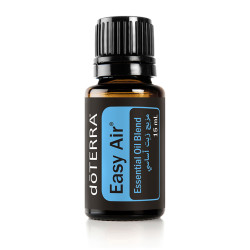
Easy Air
Respiratory blend — 15ml · Laurel leaf, eucalyptus, peppermint, tea tree, lemon, ravensara, cardamomEasy Air is doTERRA's respiratory blend, and it is the product that maps most directly onto the problem this article describes. Its composition is dominated by two families of volatile compounds with distinct roles. The oxide 1,8-cineole, supplied chiefly by eucalyptus and laurel leaf, is the most studied secretolytic constituent in aromatic plants: it is associated with thinner, more mobile airway secretions and with a calmer inflammatory tone in the respiratory mucosa — precisely the two properties compromised when the sol layer beneath the cilia loses water. Menthol, from peppermint, works on a different axis entirely: it activates the cold-sensitive TRPM8 receptors in the nasal mucosa, which generate the perception of a clear, open airway. It is worth being accurate about this, because the distinction matters in practice — menthol changes the sensation of airflow quickly and reliably, while measurable changes in the passage itself follow more slowly from the reduction in mucosal irritation. Cardamom contributes α-terpinyl acetate and a softer aromatic profile that makes the blend tolerable for prolonged diffusion rather than only for acute use, and the citrus and tea tree fractions add limonene and terpinen-4-ol. In a Gulf context the practical value is straightforward: diffused in the bedroom it supports nasal breathing overnight, which is the single change that most reliably prevents the dry-throat morning; applied to the chest in a carrier it gives a slower, longer release through the working day.
- ◆Bedroom diffusion for 30–45 minutes before sleep — supports nasal breathing through the night
- ◆Dry throat and morning throat clearing after nights under air conditioning
- ◆Blocked-feeling nose without infection, common after long indoor days
- ◆After dusty outdoor exposure — shamal days, construction areas, desert outings
- ◆Chest application: 2–3 drops in 10 drops Fractionated Coconut Oil, morning and evening
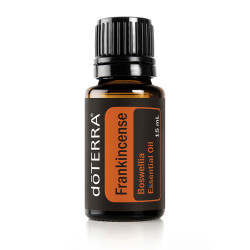
Frankincense
Boswellia carterii, frereana, papyrifera & sacra — 15ml · Steam distilledThere is no product in the doTERRA range with a stronger claim to this region. Frankincense is the resin of the Boswellia tree, and Boswellia sacra grows in the Dhofar mountains of southern Arabia; the trade in luban shaped the ports and caravan routes of this peninsula for millennia, and burning it remains an ordinary daily act in Gulf homes rather than a historical curiosity. What modern extraction adds is a different fraction of the same plant. One point deserves to be stated plainly, because it is frequently confused in wellness writing: the boswellic acids that dominate the research literature on Boswellia are large, non-volatile triterpenes, and they remain in the resin — they are essentially absent from the steam-distilled essential oil. What the distilled oil carries is the volatile monoterpene fraction, principally α-pinene, along with limonene, α-thujene and sabinene. That fraction has its own documented profile: α-pinene is associated with anti-inflammatory activity and with effects on airway smooth tone, and it is one of the compounds behind the calming, grounding character that makes frankincense a fixture in traditional practice. For the problem this article addresses, the oil earns its place on two surfaces at once — supporting a calmer inflammatory tone in a mucosa irritated by dry air and particulate, and, applied in a carrier, on skin that has been under a steep water gradient all day.
- ◆Irritated upper airway after prolonged exposure to dry or dusty indoor air
- ◆Evening facial serum: 1 drop in 4–5 drops carrier, on skin stressed by air conditioning
- ◆Diffused with Easy Air — pairs well, adds depth and a slower, resinous base note
- ◆Grounding evening ritual, culturally continuous with the region's own use of luban
- ◆Apply in the evening rather than before direct sun exposure
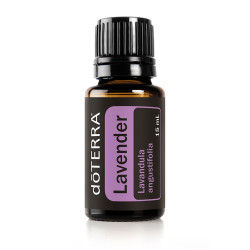
Lavender
Lavandula angustifolia — 15ml · Steam distilledLavender covers the two remaining points on the axis, and it covers them with the same two molecules. Linalool and linalyl acetate together make up the large majority of the oil, and their documented activity runs in two directions. On skin, linalool is associated with fibroblast activity and with support for the repair processes that follow barrier disruption — relevant when the barrier is not injured but chronically stressed, which is the ordinary state of skin living in conditioned air. Linalyl acetate contributes anti-inflammatory activity, and the pair together have a documented calming effect on the sensory nerve endings responsible for itch, which is why lavender is a first reach for skin that itches without any visible rash. On sleep, the evidence base is unusually good for an aromatic material: inhaled lavender is among the most consistently studied natural interventions for sleep quality and for the anxious arousal that keeps people from settling. That matters here for a mechanical reason rather than a mystical one. The repair of both surfaces described in this article — the airway epithelium and the skin barrier — is concentrated in deep sleep. A night fragmented by a dry throat and a cool, dry bedroom returns less repair than the same number of hours slept well. Lavender is the product in this protocol that addresses the recovery side rather than the exposure side, and a protocol that only addresses exposure is half a protocol.
- ◆Tight, rough or itchy skin from prolonged indoor dryness — 2 drops in a rich emollient
- ◆Applied within three minutes of showering, on skin still slightly damp, to hold water in
- ◆Bedroom diffusion, alone or with Easy Air, for depth and continuity of sleep
- ◆Itch without visible rash — the common presentation of a barrier under load
- ◆After sun and heat exposure, in a carrier, on skin that feels hot and tight
Use with care: Easy Air — for topical use dilute in a carrier oil; avoid the immediate eye area; do not apply to the face of infants or young children, as menthol and 1,8-cineole are not suitable for them. Frankincense — dilute for skin application; apply in the evening rather than immediately before direct sun. Lavender — generally well tolerated; dilute for use over large areas and on sensitive skin. Always dilute in Fractionated Coconut Oil rather than applying neat to large areas, and patch test on the inner forearm before first facial use. Persistent breathlessness, wheeze, a cough lasting more than three weeks, recurrent nosebleeds, or skin that is inflamed, weeping or spreading require medical assessment. Asthma, allergic rhinitis and eczema are diagnosed conditions with established treatments; these products are supportive and do not replace them.
The four places the load is created — and what to do in each
Why it matters most: seven or eight uninterrupted hours in one room, with breathing unconditioned by daytime activity, is the longest single exposure of the day — and the only one during which repair is supposed to be happening. The routine: diffuse Easy Air, or Easy Air with Lavender, for 30–45 minutes before sleep; a diffuser also returns a little water to the room, which is a secondary benefit worth having. Raise the air-conditioning set point by one or two degrees and use a fan for air movement instead — the sensation of coolness comes largely from moving air, and a slightly warmer room dries you less. On skin: apply the emollient with 2 drops Lavender within three minutes of showering, while the surface is still slightly damp, so the water is sealed in rather than replaced later. Expect: the morning dry throat to change within a few nights; skin texture over two to three weeks.
The load: a sealed building, a small fresh-air fraction, and a desk usually placed wherever the layout allowed rather than wherever the airflow is kindest. The routine: chest application in the morning — 2–3 drops Easy Air in 10 drops Fractionated Coconut Oil — gives slow release through the first half of the day without imposing a scent on colleagues, which a desk diffuser in a shared space inevitably does. Keep water within reach and drink on a schedule rather than on thirst; thirst is a late signal and a poor guide in cooled air. A single drop of Peppermint on the palms, inhaled, is the reasonable mid-afternoon reset. Position: if you can move, move away from the direct path of a supply vent — sitting in the airstream multiplies the drying effect on eyes and skin.
The load: a small sealed volume, an air conditioner running at maximum against a cabin that has been standing in the sun, cabin filters that in this climate load with fine dust far faster than the service interval assumes, and vents pointed directly at the face. The routine: run the first minute or two with windows open and the system on fresh air to flush the superheated volume before switching to recirculation. Angle the vents towards the windscreen and the footwell rather than at your face. Change the cabin filter on a dust-adjusted schedule, not the manual's default. A drop of Easy Air on a vent clip is pleasant, but the filter and the vent angle do more.
The load: a sharp, temporary rise in the particulate the upper airway has to clear, arriving on a system that is already running slowly because of dryness. The routine: on returning indoors, rinse the face and, if you are comfortable doing so, the nose with saline — mechanical removal is more useful than anything aromatic at this point. Then diffuse Easy Air, with Purify if the indoor air itself feels stale. Shower and reapply the Lavender emollient, since deposited particulate sits in the surface film. Timing: if you exercise outdoors, the hours around dawn are usually both cooler and lower in disturbed dust than late afternoon.
Five changes that reduce the load before any product is applied
-
01Raise the set point by two degrees
The single most effective change available, and it costs nothing. Cooler air holds less water, and the colder the coil runs the more moisture it strips before returning air to the room — so every degree lower is also a degree drier. Raising the thermostat by two degrees and adding air movement with a ceiling or desk fan usually feels identical in comfort terms, because perceived coolness depends heavily on air speed across the skin. The gain is a less severe humidity deficit across every hour of the day, in every room, without buying anything.
-
02Put water back into the rooms you spend hours in
A humidifier in the bedroom is the highest-value placement, since that is where the longest continuous exposure happens. Aim for the middle of the recommended indoor range rather than the top of it — over-humidifying in a sealed building creates its own problems with mould and dust mites, and the goal is to move away from the dry extreme, not past the comfortable middle. Clean the reservoir on schedule; a neglected humidifier disperses whatever grows in it. A diffuser running through the evening returns a small amount of water as well, which is a genuine if modest secondary benefit.
-
03Drink to a schedule, not to thirst
In hot, dry conditions sweat often evaporates before it is felt, so the usual cue that you have lost water is missing, and thirst arrives late regardless. Air-conditioned interiors compound this by removing the sensation of heat while the respiratory water loss continues on every breath. Anchoring intake to events — on waking, with each meal, on arriving and leaving the office — works better than relying on a signal that this climate has quietly disabled. Salts matter too when outdoor exertion is involved, since what leaves in sweat is not only water.
-
04Shorten and cool the shower, and seal immediately after
Long hot showers strip the lipid mortar of the stratum corneum, and in a dry environment the skin that emerges has nothing to recover with. Shorter, cooler showers with a gentle cleanser preserve far more of that lipid layer. The timing of what comes next matters as much as the product: applying an emollient within about three minutes, while the surface is still slightly damp, traps water that would otherwise be lost within the hour. Lavender in that emollient supports the repair process; the timing is what makes the water stay.
-
05Get outdoor daylight early, before the heat closes the day
Life in a hot climate becomes indoor life, and indoor life is dim by daylight standards — a well-lit office delivers a small fraction of the light intensity available outdoors even in shade. Morning light exposure is the strongest single input to circadian timing, which in turn governs the depth and continuity of the sleep on which the repair described throughout this guide depends. Twenty minutes outdoors in the early morning, before the temperature makes it unpleasant, does more for sleep quality than most evening interventions.
The questions this subject usually raises
Is indoor air really drier than the desert outside?
Often, yes — and the reason is worth understanding, because it is counter-intuitive. Air conditioning cools by passing air over a cold coil, and when warm air meets that coil, water condenses out of it and drains away. The air returned to the room is therefore both cooler and drier than the air that entered the unit. In a coastal Gulf summer the outdoor air can be extremely humid, and the machine is removing exactly that humidity as part of doing its job. Indoors, then, you can find yourself in air that holds less water than the street outside, at a temperature twenty degrees lower. The perception of dryness is not an illusion, and it is not a fault in the equipment — it is the intended mechanism of cooling, operating correctly.
Can Easy Air be diffused all night, or only before sleep?
Intermittent diffusion is the better pattern, and most diffusers offer an interval mode for exactly this reason. A continuous eight-hour run in a closed bedroom saturates the space, and olfactory receptors adapt quickly, so the perceived benefit falls away while the exposure continues. A 30–45 minute run before sleep, or an interval cycle of a few minutes on and twenty or thirty minutes off, maintains a useful concentration without over-exposure. Keep the door slightly ajar or the room otherwise ventilated. If anyone in the room is asthmatic, or if there are young children, start with shorter runs at low output and stop if there is any increase in cough or wheeze — concentrated aromatics can be an irritant in a reactive airway, which is the opposite of the intended effect.
Why do boswellic acids come up in every article about frankincense?
Because the research literature on Boswellia is genuinely substantial — and almost all of it concerns the resin or resin extracts, not the steam-distilled essential oil. Boswellic acids are large triterpene molecules with high boiling points; they do not travel over with the steam during distillation, so they stay behind in the resin. An essential oil of frankincense is therefore a different preparation of the same plant, carrying the volatile monoterpene fraction: α-pinene above all, with limonene, α-thujene and sabinene. That fraction has real documented activity of its own, and there is no need to borrow the resin's credentials to describe it. We make the distinction here because accuracy is the point of writing this way — an article that quietly attributes resin research to a distilled oil is easier to write and less useful to read.
My skin feels oily and tight at the same time. Is that possible?
It is not only possible, it is the standard presentation of a barrier under water stress, and it is routinely misread. Oil production and water content are two separate variables. A surface can be producing plenty of sebum while the water held within the stratum corneum is depleted, which is why the skin looks shiny in the T-zone and feels tight and rough at the same time. The usual response — a stronger cleanser to deal with the oil — strips more of the lipid mortar and makes the water problem worse, which the skin then answers with more oil. The way out is to treat the water side: gentler cleansing, an emollient applied while damp, and less exposure to very dry air. Lavender in the emollient supports the repair; the change in routine is what breaks the cycle.
Do I need all three products, or is one enough to start?
Start with whichever surface is complaining loudest, and add from there. If the problem is mainly the airway — dry throat on waking, a nose that blocks without infection, throat clearing through the day — Easy Air is the one to begin with, and the bedroom is where to use it. If the problem is mainly skin and sleep, start with Lavender, and pair it with the shower-and-seal timing described above, which is free and does much of the work. Frankincense is the one to add when the picture is chronic rather than acute, and when both surfaces are involved — it is also, for anyone living in this part of the world, the one with the deepest local roots. A structured assessment is the faster route to the same answer, because it tells you which of the five pillars is actually carrying the load rather than which symptom is loudest today.
Everything described in this guide concerns comfort and resilience in a demanding climate, not disease. Some presentations need proper assessment rather than environmental adjustment: breathlessness at rest or on mild exertion, audible wheeze, a cough persisting beyond three weeks, coughing blood, recurrent or heavy nosebleeds, fever with facial pain or pressure, sudden loss of smell, or skin that is inflamed, weeping, spreading or painful rather than simply dry. Children, older adults, pregnant women and anyone with diagnosed asthma, COPD, allergic rhinitis, chronic sinusitis or eczema should discuss aromatic products with their doctor or pharmacist before adding them to an existing treatment. Essential oils are supportive of a well-managed environment; they are not a substitute for prescribed medication, and they should never be used to defer an assessment that is warranted.
The climate is fixed.
What it costs you
is not.
Take the free myTERRA Wellness Index assessment and find out which of the five pillars is carrying the load right now — airway and immunity, digestion, energy and recovery, sleep and stress, or emotional balance — with a protocol built for that pattern rather than the average one.
Free Wellness Index assessment · Authentic doTERRA CPTG products · Delivery across the UAE
Related Products