
The Resins of Arabia: Frankincense, Myrrh and Copaiba
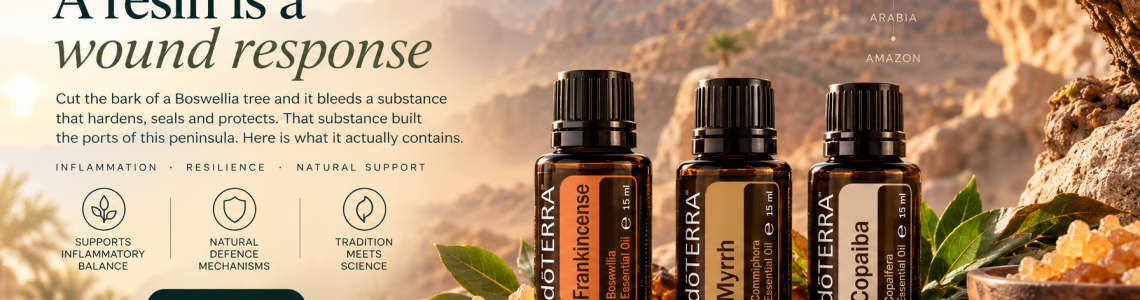
A resin is a
wound response
Cut the bark of a Boswellia tree and it bleeds a substance that hardens, seals and protects. That substance built the ports of this peninsula. Here is what it actually contains.
In the mountains of Dhofar, in southern Oman, a low, grey-barked tree grows out of limestone with almost no soil beneath it. Cut into it and within minutes a pale, milky fluid appears at the wound. Left alone for two or three weeks it hardens into translucent amber tears, which are then collected by hand. This is luban — frankincense — and for roughly three thousand years it was one of the most valuable commodities moving anywhere on earth. The incense routes that carried it north shaped the settlements, the ports and the trading families of this entire peninsula.
What makes the material worth a long article today is not its history, though the history is remarkable. It is that the biological reason the tree produces it is the same reason it interests us. A resin is not a perfume the plant makes for our benefit. It is a defensive secretion, produced at the point of injury, and its job is to seal a breach, physically block invading organisms and suppress the damage spreading inward from the wound. The plant is doing, with the tools available to a plant, exactly what our own tissue attempts after injury.
Three resins appear in this guide, and each acts on a different point of the inflammatory process. That is the argument for using them together rather than choosing between them — they are not three versions of the same idea.
myTERRATwo of the three come from the arid belt that runs from southern Arabia into the Horn of Africa. The third comes from the other side of the world, the Amazon basin, and is included here precisely because of the contrast: two traditions of resin use that developed in total isolation from one another, arriving at overlapping conclusions. Along the way we will be exact about something the wellness literature is usually vague about — what steam distillation actually carries out of a resin, and what it leaves behind.
From bark to bottle — the part most articles skip
Understanding the next three sections requires one piece of chemistry, and it is the piece that separates an accurate description from a marketing one.
What comes out of the wound is not a single substance. It is a mixture of three fractions with completely different properties. The volatile oil fraction is the light, aromatic part that evaporates — this is what you smell, and it is the only part that steam distillation can carry over. The resin fraction consists of large, heavy, non-volatile molecules, including the triterpene acids that dominate the pharmacological literature. The gum fraction is water-soluble polysaccharide, the part that makes the hardened tear sticky rather than brittle. Three fractions, three fates, three completely different preparations depending on how you extract.
Steam distillation works by carrying volatile molecules over with water vapour and condensing them on the other side. Whether a molecule makes that journey depends almost entirely on its size and boiling point. Small monoterpenes and sesquiterpenes travel easily. Large triterpene acids do not travel at all — they stay in the still. This is why the essential oil of a resin is not a concentrated version of the resin. It is a specific fraction of it, and describing that fraction accurately means talking about different molecules than the ones in the resin-extract literature.
The dominant molecules in distilled frankincense are monoterpenes, built from ten carbon atoms: α-pinene above all, with limonene, α-thujene and sabinene alongside it. They are small, they evaporate readily, they cross membranes easily and they are absorbed quickly through skin and lung. α-Pinene in particular has a well-described anti-inflammatory profile and effects on airway tone, and it is the molecule most responsible for the sharp, clean, pine-resin edge of good frankincense. It is also volatile enough that an opened bottle standing in Gulf heat loses character noticeably faster than one kept cool.
One step up in size are the sesquiterpenes, built from fifteen carbons. They are heavier, they evaporate more slowly, and they give an oil its base note and its staying power. Myrrh is dominated by them — furanoeudesma-1,3-diene, curzerene, lindestrene — and copaiba is dominated by a single one, β-caryophyllene, to a degree almost unmatched in any other common oil. Sesquiterpene-rich oils behave differently in use: they are less volatile, they linger on skin and in a room for hours, and their character develops rather than fading.
The compounds most cited in Boswellia research — boswellic acids, including AKBA — are triterpene acids with thirty carbons. They are large, heavy and non-volatile, and they do not appear in meaningful quantity in steam-distilled frankincense essential oil. They remain in the resin, and the studies concerning them almost all use resin extracts, not the oil. This is not a criticism of the oil, which has its own well-documented constituents. It is a correction of a claim that circulates constantly and that we would rather not repeat: the distilled oil is a real material with real activity, and it does not need to borrow the resin's credentials.
Resins are antimicrobial and anti-inflammatory because they have to be. A wound in bark is an open invitation to fungi, bacteria and boring insects, and a tree that cannot seal and defend the breach does not survive long in an arid environment where every wound also means water loss. The molecules that evolved for that job frequently interact with our own inflammatory signalling as well — not because the plant intended it, but because the underlying biochemistry of inflammation is old and widely shared. That is the honest version of why traditional resin medicine, developed independently on several continents, kept arriving at similar conclusions.
Why these three work better together than any one of them repeated
Inflammation is not one process with one switch. It is a sequence — recognition, signalling, recruitment, resolution — with many separate points at which it can be modulated. Most natural products that get described as "anti-inflammatory" act on one or two of those points, and combining several products that all act on the same point produces less than people expect. Combining products that act on different points is a different proposition entirely.
Frankincense, myrrh and copaiba are unusual in how cleanly they separate. Their principal constituents belong to three different molecular families and interact with three different parts of the process. That, more than heritage, is why they belong in the same protocol.
α-Pinene is small, fast-absorbing and has a documented anti-inflammatory profile alongside effects on bronchial tone. In practice this is the resin that behaves best in a diffuser and on skin at the same time, and the one whose effect people describe in terms of clarity and settling rather than sedation. It reaches tissue quickly and leaves quickly.
Myrrh's furanosesquiterpenes — furanoeudesma-1,3-diene chief among them — are associated with local analgesic and antimicrobial activity, which lines up with the oldest and most persistent traditional use of myrrh: on gums, on the mouth, and on wounds that are slow to close. It is heavy, slow and long-lasting where frankincense is quick.
β-Caryophyllene is the outlier of the three, and arguably of the whole aromatic pharmacopoeia. It is a selective agonist at the CB2 cannabinoid receptor — the peripheral receptor found on immune cells rather than in the brain — which makes it a dietary cannabinoid with no psychoactivity whatsoever. Copaiba is among the richest natural sources of it known.
Used as a set, the three cover a fast monoterpene action, two distinct sesquiterpene actions, and three different tissue affinities — airway and skin surface, mucosa and gums, deep tissue and joints. They also layer well aromatically, since a fast top note over two slow base notes is exactly how a resin blend is supposed to be built.
Six situations, matched to the right resin
the proportion of copaiba oleoresin oil commonly reported as β-caryophyllene — a concentration of a single active sesquiterpene that has few parallels among widely available aromatic materials.
Reference: typical published compositional rangesthe size of a boswellic acid molecule — large enough that it cannot be carried over by steam, which is why it belongs to the resin and its extracts rather than to the distilled essential oil.
Reference: terpenoid classification, standard chemistryroughly the span over which the incense trade moved frankincense and myrrh north out of southern Arabia — one of the longest continuously documented trades in any commodity anywhere.
Reference: general historical accounts of the incense routesFigures given for orientation, as general reference ranges rather than clinical measurements. Every body responds differently — consult a qualified professional for individual assessment.
TERRA
WI
Resins are broad-acting materials, which is a strength and a difficulty at once: they can be pointed at a joint, a gum, a scar or an evening that will not settle. The myTERRA Wellness Index scores five pillars and shows where the load actually sits for you, so the protocol follows your pattern rather than the general case.
Frankincense, myrrh and copaiba — what each one is, honestly
Below, each resin is described by what its distilled oil actually contains and what that fraction is documented to do. Where the traditional claim and the modern evidence diverge, we say so.
Frankincense
Boswellia carterii, frereana, papyrifera & sacra — 15ml · Steam distilledBoswellia sacra grows in the Dhofar mountains of southern Oman and across the Hadhramaut, in terrain so dry and so poor in soil that almost nothing else of comparable size survives there. The trees are tapped by hand, the wound is left to weep, and the hardened tears are collected weeks later — a method that has not fundamentally changed in three millennia. In Gulf homes the resin is still burned daily, and the smell of it in a majlis is not nostalgia but ordinary domestic life. doTERRA's Frankincense is a blend of several Boswellia species, which is worth knowing: frereana and sacra bring different balances of the same molecular families, and blending them produces a more complete profile than any single-species oil. The distilled oil is dominated by α-pinene, with limonene, α-thujene and sabinene supporting it — a monoterpene profile that is quick to absorb, quick to act and comparatively quick to disperse. Its documented activity covers anti-inflammatory effects and an influence on airway tone, and it is the profile behind the settling, grounding character that has made frankincense a fixture of contemplative practice in a dozen unrelated traditions. What it does not contain in meaningful quantity is boswellic acid, for the reasons set out earlier. Nothing about that diminishes the oil — it simply means the oil should be described by what it holds rather than by what the resin holds.
- ◆Evening facial serum: 1 drop in 4–5 drops carrier, on mature or sun-exposed skin
- ◆Diffused alone in the evening — the classic grounding profile, culturally continuous with luban
- ◆Layered with myrrh for a slower, deeper resin blend
- ◆One drop in the palms, inhaled, before quiet work or reflection
- ◆Store away from heat and light — monoterpenes degrade fastest of all fractions
Myrrh
Commiphora myrrha — 15ml · Steam distilledMyrrh travelled the same routes as frankincense and was frequently traded alongside it, but the two are not siblings — Commiphora is a different genus, growing across the Horn of Africa and southern Arabia, and its chemistry is almost the opposite. Where frankincense is light and monoterpene-led, myrrh is heavy, dark, and dominated by sesquiterpenes: furanoeudesma-1,3-diene, curzerene and lindestrene among them. That difference is immediately obvious in use. Myrrh does not lift out of a blend; it sinks underneath it and stays for hours. Its documented activity centres on local analgesic and antimicrobial effects, which maps onto the most persistent traditional use of the material anywhere it was traded: on the mouth and gums, and on wounds that close slowly. Egyptian, Greek, Arab and Chinese materia medica all arrive at the same two applications independently, which is the kind of convergence worth noticing. In a modern routine myrrh is the resin for patience — mature skin, scars, gum care, anything where the useful timescale is weeks rather than minutes. It is also, for that reason, the one people underuse: it does not announce itself the way a monoterpene oil does.
- ◆Gum and mouth care — 1 drop in a carrier, applied locally, not swallowed
- ◆Mature or weathered skin, in an evening oil with frankincense
- ◆Scars and slow-healing marks — used patiently, over weeks
- ◆As a base note in a diffuser blend, under a brighter oil
- ◆Avoid during pregnancy; dilute well for any skin use
Copaiba
Copaifera officinalis, coriacea, langsdorffii & reticulata — 15ml · Steam distilled oleoresinCopaiba is the deliberate outsider in this article. It is not Arabian; it comes from the Copaifera trees of the Amazon basin, where the oleoresin is not scraped from a wound in the bark but tapped from within the trunk itself, more like sap than like a tear. It is included because it demonstrates the point the whole piece is built on — that resin chemistry converges across continents that never met — and because of one molecule. β-Caryophyllene makes up an unusually large share of copaiba oil, commonly reported between forty and fifty-five per cent, and it is a genuine biochemical curiosity. It is a selective agonist at the CB2 cannabinoid receptor, the receptor expressed mainly on immune cells in peripheral tissue rather than in the central nervous system. That makes it a cannabinoid in the strict pharmacological sense, and simultaneously non-psychoactive in every sense that matters: CB2 activation does not produce the central effects associated with CB1. β-Caryophyllene is also present in black pepper, cloves and rosemary, which means most people have been consuming it in food their entire lives. What copaiba offers is concentration. In practice that makes it the resin of this trio for deep tissue: joints, muscles after real exertion, and the everyday aches that come with age and heat and work. It has almost no aroma to speak of by resin standards — soft, woody, nearly neutral — which makes it easy to add to a blend without changing its character.
- ◆Joints and muscles: 3–4 drops in 10 drops carrier, massaged into the area
- ◆After exertion, layered under Deep Blue Rub
- ◆Added to a facial oil for skin that is reactive rather than dry
- ◆Blends invisibly — useful when you want the effect without the aroma
- ◆Consistency matters more than quantity; use daily over two to three weeks
Use with care: all three resins are for external use in this guide. Dilute in Fractionated Coconut Oil before applying to skin, and patch test on the inner forearm before first facial use. Frankincense and myrrh are best applied in the evening rather than immediately before direct sun exposure. Myrrh should be avoided during pregnancy. For gum application, use a single well-diluted drop applied locally and do not swallow. Anyone taking anticoagulant medication should speak to their doctor before regular use of myrrh. Persistent joint swelling, a wound that is not closing, bleeding gums, or a mark on the skin that is changing in size, colour or shape require medical assessment rather than an oil.
Four routines, built around what you actually want
The routine: 3–4 drops Copaiba in 10 drops Fractionated Coconut Oil, massaged into the area morning and evening. Where there is real soreness after exertion, follow with Deep Blue Rub over the top — the two work on different mechanisms and the layering is deliberate. Why daily: β-caryophyllene is not an acute analgesic; the useful effect is cumulative and shows over two to three weeks of consistent use, not within an hour. What to expect: gradual change in morning stiffness before any change in acute discomfort.
The routine: 1 drop Frankincense and 1 drop Myrrh in 8–10 drops carrier, applied in the evening to clean, slightly damp skin. Frankincense supplies the fast monoterpene fraction, myrrh the slow sesquiterpene base — together they behave like a single well-built oil rather than two products layered. Timing: evening, not morning. Neither should sit on skin heading into strong Gulf sun. Patience: the timescale here is six to eight weeks. Skin turns over slowly, and anything promising visible change in a week is describing hydration, not repair.
The routine: 1 drop Myrrh in 5 drops carrier, applied locally to the gum with a clean fingertip, once daily in the evening. Do not swallow, and do not increase the quantity — more is not better with a sesquiterpene-heavy oil applied to mucosa. Context: this supports gum comfort alongside proper oral hygiene; it does not replace brushing, flossing or a dentist. When to stop and see someone: gums that bleed regularly, recede visibly, or hurt persistently are a clinical matter, not a resin one.
The routine: diffuse Frankincense alone for 30–40 minutes in the evening, or with Balance underneath it for a heavier grounding profile. Alternatively, one drop rubbed between the palms and inhaled slowly, three or four breaths, before sitting down to something quiet. Why it works: partly the documented profile of α-pinene, partly the fact that a fixed sensory cue repeated at the same hour becomes a signal in itself. Both are real; neither needs to be dressed up as more than it is. Continuity: in this region, burning luban in the evening is not a wellness practice imported from elsewhere. It is already the local one.
Five things that change how well resins work
-
01Store them properly, especially here
Monoterpenes are the first fraction to degrade, and heat accelerates it sharply. A bottle of frankincense left in a car in a Gulf summer, or on a bathroom shelf above a window, loses its top note within weeks and oxidises into something flatter and more irritating to skin. Cool, dark, tightly closed, away from any surface that gets sun. Myrrh and copaiba are more forgiving because their heavier molecules are more stable, but the principle holds. This single habit does more for the quality of what you apply than any upgrade in product.
-
02Dilute, and dilute properly
Dilution is not a way of making a bottle last longer. A carrier oil slows evaporation, extends contact time with the skin and reduces the risk of sensitisation, which is a real and cumulative phenomenon rather than a theoretical one. Neat application of resin oils to skin, repeated over months, is one of the more reliable ways to develop a reaction to a material you previously tolerated. Fractionated Coconut Oil stays liquid, has no aroma of its own and does not go rancid, which makes it the practical default in a hot climate.
-
03Give them weeks, not hours
The most common reason people conclude a resin oil does not work is that they judged it on a timescale it was never going to satisfy. Anti-inflammatory effects that operate through receptor signalling and tissue repair accumulate. Skin turns over across weeks. Joint comfort changes gradually. Set a review point three weeks out and use consistently until then, rather than reassessing every evening — daily reassessment mostly measures how you slept and what the weather did, not what the oil is doing.
-
04Build blends by weight, not by preference
A blend of three resins with no light top note is heavy and closed; a blend with only top notes disappears within the hour. The traditional structure — one fast material over one or two slow ones — exists because it works. Frankincense over myrrh is exactly that structure, and copaiba can be added to either without altering the aroma, since it is close to odour-neutral. If you want to open a resin blend up, a single drop of citrus does it, but keep it to one drop: it is a hinge, not a component.
-
05Keep the traditional and the biological claims separate
Both are worth something, and mixing them weakens each. That frankincense has been burned in this region for three thousand years is a fact about culture and continuity, and a good reason to value it. That α-pinene has a documented anti-inflammatory profile is a fact about chemistry. Neither one proves the other, and an article that uses the history to imply the pharmacology — or the pharmacology to dignify the history — is doing something dishonest with both. Held apart, they support each other far more convincingly.
The questions resins usually raise
Is the essential oil the same thing as the resin I burn at home?
Same plant, different material. The tears you burn on charcoal contain everything the tree produced: the volatile oil, the heavy resin acids and the water-soluble gum. Burning releases the volatile fraction into the room and destroys or transforms much of the rest through combustion. Steam distillation instead separates the volatile fraction cleanly and leaves the heavy compounds behind in the still. So the bottle holds a purified, concentrated version of one part of the resin, and the burning tear delivers a broader but partly altered mixture along with smoke particulate. Neither is superior in the abstract. If you want the aromatic molecules delivered cleanly onto skin or into air without combustion products, the oil is the better vehicle; if you want the domestic ritual as it has always been practised here, the resin is the point.
Copaiba activates a cannabinoid receptor. Should that concern me?
No, and the reason is worth understanding rather than taking on trust. There are two well-characterised cannabinoid receptors. CB1 is concentrated in the central nervous system and is the one responsible for the psychoactive effects associated with cannabis. CB2 is expressed mainly on immune cells in peripheral tissue and has no such role. β-Caryophyllene binds selectively to CB2 and effectively not at all to CB1, which is precisely why it can be classified as a dietary cannabinoid while remaining entirely non-psychoactive and unregulated. It is also not exotic: β-caryophyllene occurs in black pepper, cloves, oregano and rosemary, so anyone who cooks has consumed it regularly for years. Copaiba is simply an unusually concentrated source.
Why does your description of frankincense differ from what I read elsewhere?
Because most descriptions attribute boswellic acid research to the essential oil, and that attribution is not correct. Boswellic acids are large, non-volatile triterpene acids that stay in the resin during steam distillation; the substantial body of research on them concerns resin extracts and standardised preparations, not distilled oil. It is an easy error to make and an easy one to repeat, since the research is impressive and the plant is the same. We separate them because the distilled oil has a real, documented constituent profile of its own — an α-pinene-led monoterpene fraction with its own activity — and does not need borrowed evidence. An article that quietly transfers the resin's credentials to the oil is easier to write and considerably less useful to read.
Which of the three should I buy first?
Start from the problem rather than from the price list. If what bothers you is joints, stiffness in the morning or recovery after exertion, buy Copaiba first — it is the one of the three that reaches deep tissue, and it is also the most affordable. If the interest is skin, or an evening that will not settle, start with Frankincense; it is the most versatile of the three and the one you will reach for most often, though it is also the most expensive in the range. Myrrh is the specialist: buy it when gums, scars or mature skin are specifically the point, or when you want a proper base note under frankincense. If you are buying one bottle and are undecided, Frankincense is the safe answer. A structured assessment gets you to the right answer faster than a general recommendation, because it looks at which pillar is actually carrying the load for you.
Can I use these on children, or during pregnancy?
Myrrh should be avoided during pregnancy — that is the clearest of the cautions in this group and it is not worth testing. Frankincense and copaiba are generally regarded as gentler materials, but pregnancy is a situation where the sensible default is to ask a doctor or midwife before adding anything aromatic to a routine, rather than to reason from general tolerability. For children, dilution matters far more than it does for adults, and any facial or mucosal application should be avoided altogether. Anyone on anticoagulant medication should raise myrrh specifically with their doctor before using it regularly. None of these are dramatic warnings; they are the ordinary care that any concentrated botanical material deserves.
This guide is about comfort, resilience and the intelligent use of botanical materials — not about treating disease. Several situations need proper clinical assessment rather than a resin: joint swelling that is hot, red or rapidly worsening; a wound that is not closing or is spreading; gums that bleed regularly or recede; any mark on the skin that changes in size, colour, outline or texture; and persistent pain that wakes you at night. Anyone with an autoimmune condition, anyone taking anticoagulant or immunosuppressant medication, and anyone who is pregnant or breastfeeding should discuss aromatic products with their doctor before adding them to an existing regime. Essential oils support a well-managed routine; they do not replace prescribed treatment, and they should never be a reason to postpone an assessment that is warranted.
Three thousand years
of use.
One question left.
Which of these belongs in your routine, and for what? Take the free myTERRA Wellness Index assessment and find out which of the five pillars is carrying the load right now — immunity, digestion, energy and recovery, sleep and stress, or emotional balance — with a protocol built for that pattern rather than the average one.
Free Wellness Index assessment · Authentic doTERRA CPTG products · Delivery across the UAE