The Shared-Air Problem: Offices, Schools and the Air a Hub City Recirculates
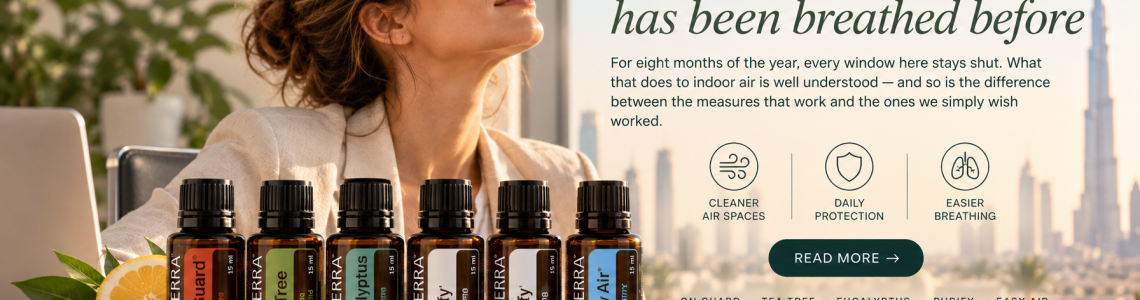
The air in this room
has been breathed before
For eight months of the year, every window here stays shut. What that does to indoor air is well understood — and so is the difference between the measures that work and the ones we simply wish worked.
An open-plan office in September. Forty people, one air-handling system, a temperature someone in facilities decided on in 2019, and a window that has not opened since the building was finished. Somebody two desks away has come back from leave with a cough. Over the following fortnight it moves through the floor in the way it always does, and everyone blames the air conditioning — which is partly fair and mostly imprecise, because the phrase "it's the AC" covers at least four separate mechanisms, only some of which you can do anything about.
This is worth getting right rather than guessing at, particularly here. A city that is also one of the world's busiest transit hubs, where classrooms, malls, gyms and offices are sealed and cooled for most of the year, and where the outdoor air itself carries a significant load of fine dust, is a genuinely distinctive indoor-air environment. It is also one where a great deal of confident nonsense is sold.
Aromatics have a real place in a closed, air-conditioned home. That place is not disinfecting the air you breathe, and any brand telling you otherwise is selling you something other than the truth.
myTERRASo this guide is structured around that boundary. First, how shared air actually works — the two routes of transmission, what a filter catches and what it misses, why very dry air weakens the nose's own defences, and what months of construction dust add. Then what genuinely helps, in order of how much it helps. Five products appear here because each has a defensible role: On Guard and Purify for surfaces and for the smell of a closed home, Tea Tree for its documented laboratory profile in topical use, Eucalyptus and Easy Air for the sensation of clear breathing in dry conditioned air.
Six things worth understanding before you buy anything
None of this is controversial, and none of it is specific to essential oils. It is ordinary indoor-air and respiratory physiology, and it decides which interventions are worth your money.
Respiratory infections move between people in two broad ways: through the air, as droplets and finer particles released when someone breathes, talks or coughs, and through contact, when those particles land on a surface or a hand and are then carried to a face. The two routes are addressed by completely different measures — ventilation and filtration for the first, hand and surface hygiene for the second — and confusing them is the most common reason people spend money without effect. Nothing you diffuse into a room addresses either route in the way that opening a window, changing a filter or washing your hands does.
Cooling air costs money, so a system in this climate recirculates most of what is already inside and brings in only a modest proportion of outdoor air. That is a reasonable engineering trade-off, but it means indoor air in a sealed building is largely the same air, repeatedly cooled and repeatedly passed through a filter. Filters are rated by how small a particle they capture, and a basic one fitted to keep dust off the coil is not the same as one specified to capture fine particulate. It is worth knowing which your building or villa has, because it is the difference between a filter protecting the machine and a filter protecting you.
Your airways clear themselves continuously. A thin layer of mucus traps particles and microbes, and a carpet of microscopic hairs moves that layer steadily up and out to be swallowed without you noticing. The system depends on moisture. Air conditioning cools by condensing water out of the air, so months of hard cooling means months of low humidity, and in dry air the mucus thickens and that clearance slows. This is the most under-appreciated item on the list: long before anything reaches you, the front line of your own defence has been made less efficient by the thing keeping you comfortable.
Fine airborne dust is a permanent feature of this region rather than an occasional event, and it rises sharply during the windy periods when a haze settles over everything for days. Add the construction that runs continuously in a fast-growing city. That load reaches indoors through doors, lift shafts and the fresh-air intake, settles on surfaces, and clogs filters far faster than a manufacturer's generic replacement interval assumes. Anyone who has opened a filter housing after a dusty month has seen the answer. It also means indoor congestion here is frequently irritant rather than infectious, which matters because the two feel identical and respond to different things.
This is one of the most connected places on earth, which is one of the reasons people move here and also a straightforward epidemiological fact: arrivals and departures from everywhere, all year, plus international schools where children mix with families who travelled somewhere different each holiday. Add aircraft cabins, where filtration is generally good but proximity is unavoidable, and airport terminals, where it is the opposite. None of this is a reason for anxiety — it is a reason why the ordinary measures matter slightly more here than in a quiet town, and why the term after a long holiday is reliably the busy one for coughs.
Several essential oil constituents have well-documented antimicrobial activity in laboratory conditions — measured on a plate or a test surface, at concentrations far above anything present in a diffused room. That is real chemistry and it is the basis for their traditional use on surfaces and, diluted, on skin. It is not evidence that diffusing an oil sterilises the air in a living room, and we will not pretend otherwise. The honest positions are these: on surfaces and hands, aromatic cleaning products do useful work; in the air, they change how a closed home smells and how easy breathing feels; neither prevents or treats infection.
Four layers, ranked by how much they actually do
If you only change one thing, change the first of these. The order below is deliberate and it is not the order in which these things are usually sold — the cheapest and least glamorous measures sit at the top, and the aromatic layer sits at the bottom, where it belongs.
That does not make the last layer pointless. It makes it the finish rather than the foundation, which is a reasonable thing for a wellness product to be.
Diluting indoor air with outdoor air reduces whatever has accumulated in it. The seasonal trick here is timing: early morning and late evening in the cooler months are comfortable enough to open up properly for ten or fifteen minutes, and even in summer a short purge costs less than most people assume. In a villa, cross-ventilation for a few minutes beats an hour with one window ajar.
A filter rated for fine particulate, changed on the schedule this region's dust demands rather than the one printed on the box, does real work — and a neglected filter is worse than a cheap one, because it restricts airflow and becomes a reservoir. Check the housing after a dusty week and you will never trust a generic interval again. A portable unit with a proper filter is a reasonable addition in a bedroom.
Bringing a very dry room back into a comfortable middle range supports the airway clearance described above and reduces the dry throat, thickened mucus and night-time congestion that so many people here attribute to illness. Both extremes cause problems: too dry irritates, too damp encourages mould and dust mites. A cheap hygrometer removes the guesswork entirely.
Hand hygiene remains the single most effective personal measure against contact transmission, and it is not replaced by anything in a bottle of oil. What aromatic products do well is make routine cleaning of high-touch surfaces something you are willing to do often, and make a closed home smell like somewhere cared for rather than somewhere sealed. Both are worth having on their own terms.
Six settings, and what is worth doing in each
the relative humidity band generally recommended for indoor comfort. Below it, airway clearance and comfort suffer; above it, mould and dust mites become the problem instead.
Reference: general indoor air quality guidancethe duration standard hand-hygiene guidance gives for washing with soap and water — still the most effective single personal measure against contact transmission, and not replaceable by anything aromatic.
Reference: standard hand hygiene guidancethe age below which oils high in 1,8-cineole or menthol should be kept away from the face and nostrils entirely, and diffusion kept brief, low and well ventilated.
Reference: standard aromatherapy safety practice for young childrenFigures given for orientation, as general reference points rather than clinical measurements. Every body responds differently — consult a qualified professional for individual guidance.
TERRA
WI
Exposure is only half of it. The other half is how much load you are already carrying — short nights across a long term, a heavy travel schedule, a digestive system under strain. The myTERRA Wellness Index scores five pillars and shows where that weight actually sits, which is a more useful place to start than buying another spray.
On Guard, Tea Tree, Eucalyptus, Purify and Easy Air
Each of these is here for a specific job, and the job is stated plainly in each case. Two are for surfaces and the smell of a closed home, one for diluted topical use, two for the sensation of clear breathing in dry conditioned air. None of them prevents or treats an infection, and none replaces ventilation, filters, humidity or handwashing.
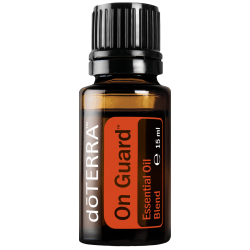
On Guard
Protective blend — 15ml · Wild orange peel, clove bud, cinnamon bark and leaf, eucalyptus leaf, rosemaryOn Guard is the most widely used blend doTERRA makes and also the one most often described in terms that go well beyond what can be supported. So, precisely: its constituents include eugenol from clove, cinnamaldehyde from cinnamon bark, limonene from orange peel and 1,8-cineole from eucalyptus and rosemary — a group with substantial documented antimicrobial activity in laboratory testing. That is the legitimate basis for its traditional role in cleaning, and it is where the blend genuinely earns its place: a few drops in a spray bottle makes wiping door handles, taps, switches and a desk something that smells good enough to do daily, and frequency is what makes surface hygiene work. Diffused, it makes a sealed home smell warm and clean in the way a spiced kitchen does. What the laboratory data does not establish is that diffusing it disinfects the air of a room, and you will not read that claim here. Two cautions are genuine rather than boilerplate: cinnamaldehyde and eugenol are among the more common skin sensitisers in aromatics, so heavy dilution is essential and undiluted skin use is not advisable; and it can mark or dull some varnished, plastic and natural stone surfaces, so test an inconspicuous corner first.
- ◆Cleaning spray: around 10 drops in 250ml water with a little unscented soap, shaken before each use
- ◆High-touch surfaces daily when someone at home is unwell — handles, taps, switches
- ◆Test on an inconspicuous area of stone, varnish or plastic first
- ◆Diffused briefly in a living space, not continuously
- ◆Dilute heavily in Fractionated Coconut Oil for any skin use
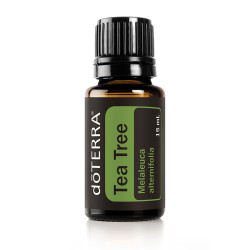
Tea Tree
Melaleuca alternifolia — 15ml · Steam distilled from the leavesTea tree has the strongest laboratory record of anything in this article. Its dominant constituent, terpinen-4-ol, has been studied extensively for antimicrobial activity against bacteria and fungi in vitro, and there is a reasonable clinical literature on topical use for minor skin problems — the kind of blemishes, small irritations and fungal nuisances that a hot, humid, heavily perspiring climate produces in abundance. That is where it belongs: diluted, on skin, on a specific spot. It is not for internal use under any circumstances, and diffusing it does not clean a room. A specific point about storage matters more with this oil than most: tea tree oxidises with exposure to air, light and heat, and oxidised tea tree is considerably more likely to irritate skin than fresh oil. In a climate like this, that means a tightly closed bottle, kept genuinely cool and dark, and a willingness to replace an old one rather than persist with it. Good-quality oil is also high in terpinen-4-ol and low in 1,8-cineole, which is worth knowing when comparing products.
- ◆Diluted, on a specific spot rather than spread across the skin
- ◆Patch test on the inner forearm before first use; stop if it irritates
- ◆Gym kit, shoes and bags — the humid-climate problem it is best at
- ◆Store tightly closed, cool and dark; oxidised oil irritates
- ◆Never taken internally, and never in or near the eyes
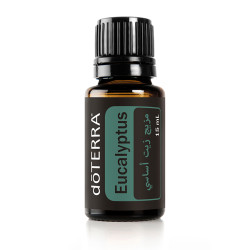
Eucalyptus
Eucalyptus radiata — 15ml · Steam distilled from the leavesEucalyptus is what most people mean when they say an oil smells like breathing more easily, and the reason is one molecule: 1,8-cineole, also called eucalyptol, which dominates the oil and has been studied in relation to airway secretions and bronchial tone. Its cooling, camphoraceous character also produces a strong subjective sense of openness through the nose, which is genuinely welcome in air that has been dried by months of cooling. Two honest qualifications. The subjective feeling of a clear nose and a measurable change in airflow are not the same thing, and much of what a diffuser delivers is the former. And the same molecule that makes it useful makes it the oil in this article requiring the most care: 1,8-cineole and menthol-type constituents must be kept away from the face and nostrils of children under six, and anyone with asthma should start with very brief, low-output diffusion in a ventilated room and stop if it provokes tightness rather than ease. Eucalyptus radiata is the gentler of the common eucalyptus species, which is why it is the sensible choice for household use.
- ◆Brief diffusion in a ventilated room, especially on dusty days
- ◆One drop on a tissue held nearby rather than steam inhalation for children
- ◆Diluted on the chest or upper back for adults, never the face
- ◆Asthma: start very short and low, and stop if it tightens rather than eases
- ◆Not for children under six near the face or nostrils
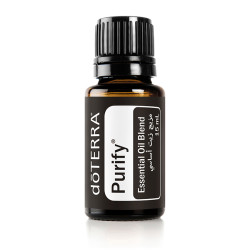
Purify
Cleansing blend — 15ml · Lemon peel, Siberian fir, citronella, lime peel, melaleuca, cilantroPurify does one thing very well and it is worth naming it accurately: it deals with smells. A home sealed for eight months accumulates the residue of cooking, laundry that dried slowly, bins, drains, shoes and gym kit, and because olfactory receptors adapt within minutes, the people living there are the last to notice. The blend is built for exactly that — lemon and lime peel for brightness, Siberian fir for a clean coniferous base, citronella for its sharp familiar lift, melaleuca and cilantro filling out the middle. It is the blend to reach for after a dusty week, in a utility room, around bins, or in a bathroom with a drain that announces itself. The name invites a stronger interpretation than the evidence supports, so to be clear: neutralising and masking odour is not the same as sterilising air, and a pleasant-smelling room is not a clean one. The practical caution is the citrus content — lemon and lime are cold-pressed peel oils and therefore phototoxic on skin, which matters a great deal in this climate. Use it for rooms and surfaces, not on yourself.
- ◆Utility rooms, bins, drains, shoe cupboards and gym bags
- ◆A few drops on a cloth in the laundry basket between washes
- ◆Diffused after cooking, or after a week of dust
- ◆Phototoxic — keep it off skin that will see the sun
- ◆Not a disinfectant, and not for internal use
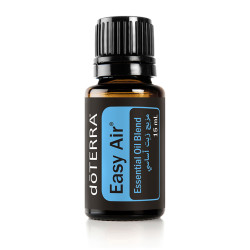
Easy Air
Respiratory blend — 15ml · Laurel leaf, peppermint, eucalyptus, melaleuca, lemon, cardamom, ravintsara, ravensaraEasy Air is the blend most people here end up using most, and the reason is specific to this climate rather than to illness: months of hard cooling produce very dry air, dry air thickens the mucus layer that keeps the nose working, and the result is congestion that appears mainly at night, a dry throat before dawn and a nose that feels blocked without anything actually being wrong. The blend is constructed around that sensation — laurel leaf and eucalyptus contributing 1,8-cineole, peppermint bringing menthol and its cooling trigeminal effect, melaleuca, lemon, cardamom, ravintsara and ravensara filling out the middle. Diffused in the evening it makes breathing feel easier and a closed bedroom feel less stale, and used alongside the actual fix — raising the room's humidity back into a reasonable range — it is a sensible part of an evening. Two boundaries, stated plainly. First, this is comfort and sensation, not treatment: it does not manage asthma, treat a chest infection or replace a prescribed inhaler, and anyone using one should talk to their doctor before adding aromatics. Second, the menthol and 1,8-cineole content puts it in the same category as Eucalyptus for children — keep it away from the faces of the under-sixes, diffuse briefly at low output in a ventilated room, and ask a paediatrician before regular use with young children.
- ◆Diffused for the last 30 minutes of the evening, intermittently
- ◆Alongside raising room humidity — the blend is the comfort, humidity is the fix
- ◆One drop on a tissue on flights, where the cabin air is drier still
- ◆Not a substitute for an inhaler or any prescribed treatment
- ◆Children under six: not near the face; ask a paediatrician first
Use with care: None of these products prevents, treats or cures any infection, and none replaces medical advice, prescribed medication or vaccination decisions taken with your doctor. On Guard contains cinnamaldehyde and eugenol, among the more common skin sensitisers in aromatics — dilute heavily in Fractionated Coconut Oil for any skin contact, keep away from eyes, and test on an inconspicuous area before using it on stone, varnish or plastic. Purify contains cold-pressed citrus peel oils and is phototoxic on skin — keep it to rooms and surfaces. Tea Tree is for diluted topical use only, never internal, and oxidised oil should be replaced rather than used. Eucalyptus and Easy Air contain 1,8-cineole and, in Easy Air, menthol: keep both away from the face and nostrils of children under six, diffuse briefly at low output in a ventilated room, and take paediatric advice before regular use with young children. Anyone with asthma or a respiratory condition should start with very short, low-output diffusion and stop if it provokes tightness. Anyone pregnant, breastfeeding, or managing a diagnosed condition should speak to their doctor before regular use. Keep all oils out of reach of children and away from pets — cats and birds are particularly sensitive, and a room being diffused should always have a way out.
Four routines, in the order they are worth your effort
Ventilation: one deliberate purge a day — windows genuinely open, opposite sides of the home if you can, for ten to fifteen minutes. Early morning is the comfortable window for most of the year. Filters: check yours after a dusty week rather than trusting the printed interval, and find out what your system is actually rated to capture. Humidity: a cheap hygrometer, and a humidifier if the reading sits low — cleaned regularly, because a neglected one becomes its own problem. Then the aromatic layer: Easy Air or Eucalyptus diffused intermittently in the evening, for comfort rather than for cleaning.
The primary measure: soap and water for twenty seconds, particularly on coming home, before eating and after public transport or a shopping trip. Nothing in this article improves on it. The spray: around 10 drops of On Guard in 250ml of water with a little unscented soap, shaken before each use, for handles, switches, taps and desks. The point is that a spray you like the smell of gets used daily, and frequency is the whole mechanism. When someone at home is unwell: separate towels, that bathroom ventilated, handles and taps wiped daily. What not to bother with: spraying the air.
On the flight: cabin air is drier than almost anywhere on the ground, so water rather than more coffee, and a drop of Easy Air on a tissue if your nose dries out. Wipe the tray table and armrest — contact surfaces do more here than the air does. In the hotel: the same handful of surfaces, handles and remote control; and if the room is stale, ventilate rather than mask. In the bag: Tea Tree diluted for the minor skin nuisances of a humid climate, and a small bottle of carrier oil. On return: a purge of the closed apartment before anything else.
The honest hierarchy: sleep, food, water and movement do more for how you weather a long term than any product does, and a household that is short on all four will catch whatever is going round regardless of what is in the diffuser. The dusty months: expect more irritation, not more infection, and treat it as an air-quality problem. And keep perspective: a few colds a year in a hub city with school-age children is normal, not a failure of your routine.
Five things worth getting right
-
01Hygiene first, aromatics last
This ordering is not modesty, it is accuracy. Handwashing, ventilation, a maintained filter and reasonable humidity carry almost all of the effect available to a household. Aromatics make cleaning pleasant enough to happen often and make a sealed home smell cared for, both of which are real benefits. If a brand presents the last item as a replacement for the first four, that is a marketing decision rather than a technical one, and it is worth noticing who is making it.
-
02Diffuse in intervals, and ventilate
Olfactory receptors adapt within minutes, so a diffuser running for hours delivers a strong smell to anyone walking in and almost nothing to the people in the room. Intermittent mode keeps the signal perceptible, uses a fraction of the oil, and avoids saturating a closed space with aerosolised oil — which matters most in a sealed, air-conditioned home where nothing leaves on its own. A room being diffused should always have a way out, and nobody should be shut in with it.
-
03Respect the sensitisers
Cinnamon bark and clove — and therefore On Guard — contain cinnamaldehyde and eugenol, among the most common skin sensitisers in aromatics. Sensitisation is not a dose problem you can push through; once established, it tends to be permanent, and it is provoked by repeated undiluted contact more than by a single exposure. Dilute heavily, keep these blends off unbroken daily skin contact, and wear gloves if you are cleaning with a stronger mix. Tea tree needs the same respect for a different reason: oxidised oil irritates, so replace it rather than finishing it.
-
04Children under six are a different category
Oils high in 1,8-cineole or menthol — Eucalyptus, peppermint, Easy Air and On Guard among them — should be kept away from the face and nostrils of young children entirely, not simply used more sparingly. Diffusion in a child's room should be brief, at low output, in a ventilated space, and ideally not while they are asleep in it. Anything topical should be heavily diluted and applied to the soles rather than the chest or face. For infants and toddlers, and for any child with asthma or a respiratory condition, ask their doctor first.
-
05Fix the cause before you cover the symptom
A stale-smelling home, a dry throat every morning and a blocked nose that appears only indoors are all information. They point at air exchange, humidity and filters, and each has a real fix that costs less than a year of oils. Reaching for a diffuser first is not harmful, but it can mean a genuine problem goes unaddressed for months behind a pleasant smell. Deal with the air, then use the aromatics for what they are good at — which is making a well-kept home feel like one.
The questions this subject usually raises
Do essential oils kill germs in the air?
In a room you are living in, no — and it is worth being direct about that, because the claim is everywhere. Several oil constituents have well-documented antimicrobial activity in laboratory testing, but those results come from direct contact at concentrations far above anything a diffuser puts into the air of a living room, where the oil is dispersed, diluted and constantly diluted further by whatever ventilation exists. What aromatics do well is surfaces, where contact and concentration are both on your side, and comfort, where a sealed home smells better and breathing feels easier. If you want to reduce what is in the air itself, the tools are ventilation and filtration, and neither comes in a bottle.
Can I use On Guard as my main cleaning spray, and on what surfaces?
For everyday wiping of high-touch surfaces, yes, and it works well for the reason most cleaning advice comes down to: a product you like using is one you use often. Around 10 drops in 250ml of water with a little unscented soap, shaken before each use since oil and water separate. Two limits. It is not a registered disinfectant, so it is not the right choice where actual disinfection matters — raw meat preparation, or a bathroom where someone has a gastrointestinal infection; use a proper product for those. And essential oils can dull or mark varnished wood, some plastics and porous natural stone, so test an inconspicuous corner first. Gloves are sensible if you are cleaning with it regularly.
Is it safe to diffuse Eucalyptus or Easy Air around my children?
With real care, and less freely than most marketing suggests. The constituents that make these blends feel clearing — 1,8-cineole and menthol — are the same ones that require caution in young children, and the established practice is to keep them away from the face and nostrils of the under-sixes entirely rather than simply using less. Diffusion in a shared family room, briefly and at low output with the door open, is a different matter from a diffuser running in a small closed bedroom while a toddler sleeps; the second is the situation to avoid. For infants, for any child with asthma or a respiratory condition, and before making it a nightly habit, ask their doctor. Lavender, well diluted, is the usual starting point for children instead.
What humidity should I aim for, and won't a humidifier cause mould?
A middle band is the target — roughly forty to sixty per cent relative humidity is the range generally recommended for indoor comfort, and a hygrometer costing very little tells you where you actually are rather than where you assume. Heavily air-conditioned rooms here often sit well below it. The mould concern is legitimate and it is a reason to measure rather than a reason to avoid humidifying: problems arise from pushing a room high, from condensation on cold surfaces, and from a humidifier's own reservoir when it is never cleaned. Empty and dry it regularly, keep it away from walls and cold glass, and stop adding moisture once the reading is comfortably mid-range. Do not add essential oils to a humidifier that is not designed for them.
Do I need an air purifier, or is the building's system enough?
It depends entirely on what your system is rated to capture and how well it is maintained, and most people have never been told either. A well-specified, well-serviced central system does a great deal; a basic filter fitted mainly to keep dust off the machinery does much less for you. Given the dust load in this region, a portable unit with a proper particulate filter in the bedroom — the room where you spend the most continuous hours — is a reasonable and modest investment. Two practical notes: sizing matters more than features, since a unit too small for the room simply cannot cycle the air often enough; and ionisers or ozone-generating devices are a different category and best avoided in occupied rooms.
Shortness of breath, chest pain, a high or persistent fever, coughing up blood, a cough lasting more than three weeks, or symptoms that worsen rather than settle after a few days should be assessed by a doctor rather than managed at home. The same applies to any asthma that is becoming harder to control, to recurrent chest infections, and to anyone who is pregnant, immunosuppressed, elderly or managing a chronic condition and becomes unwell. Nothing in this guide prevents, diagnoses or treats any infection or respiratory condition; it describes indoor air quality, ordinary hygiene, and the limited and specific roles aromatic products can honestly play alongside them. Decisions about medication, inhalers and vaccination belong with your doctor, and nothing here should delay an assessment that is warranted.
Clean air is built,
not sprayed.
Take the free myTERRA Wellness Index assessment and find out which of the five pillars is carrying the load right now — immunity, digestion, energy and recovery, sleep and stress, or emotional balance — with a protocol built for that pattern rather than the average one.
Free Wellness Index assessment · Authentic doTERRA CPTG products · Delivery across the UAE
Related Products