

Late Dinners and the Long Evening: Digestion on a Gulf Schedule

Dinner at eleven,
and a stomach that notices
Your digestive system runs on a clock of its own, and nobody consulted it about the local dining hour. Here is what it is actually doing, and which of the usual complaints have a real fix.
The reservation is for nine, which means food arrives at ten and the last of it at eleven. It is a good meal. Everyone is still there at midnight because that is how evenings work in this part of the world, and nobody is being unreasonable — the heat of the day makes a late social life entirely rational, and the whole city is arranged around it. You get home at half past twelve, lie down, and spend the next hour aware of your own stomach in a way you were not at nine.
This is one of the most common adjustments people describe after moving here, and it is usually treated either as a moral failing or as a reason to buy something. It is neither. It is a mismatch between a social schedule and a set of biological rhythms that are quite well characterised, and understanding them tells you which of the popular remedies are worth anything.
The digestive system is not simply a tube that processes whatever arrives. It has its own timing, its own quiet housekeeping cycle, and a strong preference for the hours in which most of us are least likely to eat.
myTERRAWhat follows is the physiology first — gastric emptying and why lying down changes everything, the housekeeping waves that only run when you are not eating, what heat and fluid loss do to transit, and the fibre problem a restaurant-heavy week creates. Then the practical part, and an unusually clear line about evidence: peppermint has a genuine clinical literature behind it, and that literature is about a pharmaceutical preparation rather than a drop from a bottle. Four products appear here — ZenGest, Peppermint, Lemon and Copaiba — with what each can and cannot do stated plainly.
Six things your digestive system is doing while you eat late
Ordinary gastroenterology, none of it specific to essential oils, and all of it useful for working out which complaint you actually have.
Almost every part of the system follows a daily rhythm: the rate at which the stomach empties, the secretion of enzymes and bile, the movement of the colon, and how efficiently the body handles a load of carbohydrate. Broadly, that machinery is tuned for the earlier part of the day and winds down towards the night — which is exactly when the largest meal tends to arrive here. The same plate of food at eight in the evening and at half past eleven is not the same event physiologically, and the difference is not a matter of willpower or of eating "too much". It is timing meeting a rhythm.
The junction between the oesophagus and the stomach is a muscular valve, and while you are upright, gravity helps it. Lie down with a full stomach and that assistance disappears, which is why reflux so often appears only at night and only after a late meal. Two things make it more likely: volume, because a distended stomach puts the valve under pressure, and fat content, because fat slows gastric emptying and keeps the stomach full for longer. The practical consequence is the most reliable single piece of advice in this article — leave a gap between the last substantial food and lying flat.
Between meals, the small intestine runs a slow sweeping contraction — a housekeeping cycle that clears residue and keeps bacterial populations from settling where they should not. It only operates in the fasted state, and eating interrupts it and resets the sequence. A day of continuous grazing, with something in the mouth every ninety minutes, therefore suppresses one of the system's own maintenance functions. This is a reasonable argument for leaving genuine gaps between meals rather than for any particular fashionable schedule, and it explains why constant snacking can produce bloating in someone who is not overeating at all.
In a climate like this you lose water continuously without noticing much of it, and a body short of fluid conserves it — including by reabsorbing more water from the colon, which makes stool harder and transit slower. This is a large part of why so many people become constipated within weeks of arriving, and why the answer is usually water, salt in reasonable amounts, and movement rather than a supplement. Air-conditioned offices hide the loss: you feel cool, so you drink less, while the dry air continues to take moisture from every breath you exhale.
Eating out often — genuinely common here, and one of the pleasures of the place — tends to mean more refined starch and fat and considerably less fibre than cooking at home. Fibre matters for two separate reasons: the insoluble kind adds bulk and speeds transit, and the fermentable kind is what the bacteria in your colon actually live on. Several weeks of restaurant food changes what that population has to work with, and the effects show up as altered stool, more gas or less comfort. This is a shopping-list problem rather than a supplement problem, and it responds quickly.
The digestive tract has its own extensive nerve network and a constant two-way connection with the brain, which is why a stressful week is felt in the abdomen and why a nervous morning changes what the bowel does. This is ordinary neurology rather than anything mystical, and it has a practical implication: when symptoms track your workload rather than your food, changing the food will not fix them. It also means that part of what any pleasant, repeated routine achieves after a heavy meal is real — though the mechanism is the routine and the state it produces, not a chemical acting on the stomach wall.
Four patterns, because "bloating" describes at least four different things
Most people arrive at this subject with one word for a range of quite different experiences, and that vagueness is why the wrong remedy gets tried for months. It is worth working out which of these you actually have, because they respond to different changes.
One caution before the list: these are ordinary patterns in otherwise well people. Anything persistent, worsening, or accompanied by the warning signs set out at the end of this article belongs with a doctor rather than on a chart.
Heaviness high in the abdomen within an hour, worse after a rich or large meal, easing as the stomach empties. Usually about how much arrived and how quickly it can leave. The levers are portion size, fat content and the gap before lying down — not the composition of your gut bacteria.
Distension that builds through the afternoon or evening, often with wind, and tracking particular foods rather than meal size. This is fermentation in the colon, which is normal and useful in moderation. Levers: which fermentable foods, how much at once, how quickly fibre was increased, and transit speed.
Burning behind the breastbone, a sour taste, a cough or a hoarse morning voice. Strongly tied to lying down after a large late meal. Levers: the gap before bed, meal size and fat, raising the head of the bed. Note that peppermint can make this pattern worse rather than better.
The most common complaint among new arrivals, and the most responsive. Heat-driven fluid loss, a low-fibre restaurant week, long flights and a disrupted daily routine account for the great majority of cases. Levers, in order: water, fibre increased gradually, daily movement, and a consistent morning routine.
Six evenings, and what is worth doing in each
the gap between a substantial meal and lying flat that general reflux guidance suggests. The single most reliable change available on a late-dining schedule, and it costs nothing.
Reference: general reflux and lifestyle guidancethe approximate interval at which the gut's housekeeping contractions recur in the fasted state. Eating interrupts the cycle, which is the argument for real gaps between meals.
Reference: standard gastrointestinal motility physiologythe daily fibre intake commonly recommended for adults — considerably more than a restaurant-heavy week tends to deliver. Raise it gradually, with water, or it causes the symptom it is meant to fix.
Reference: general dietary fibre recommendations for adultsFigures given for orientation, as general reference points rather than clinical measurements. Every body responds differently — consult a qualified professional for individual guidance.
TERRA
WI
Digestive complaints often turn out to be downstream of something else: short nights, a heavy travel month, sustained stress. That matters, because a dietary experiment aimed at the wrong cause can run for months without result. The myTERRA Wellness Index scores five pillars and shows where the load actually sits.
ZenGest, Peppermint, Lemon and Copaiba
These four occupy quite different positions, and the differences are worth reading before choosing. One is a traditional carminative blend, one has a real clinical literature that is about a different preparation entirely, one is largely a matter of freshness and routine, and one has an interesting mechanism and modest human evidence. None of them treats a digestive condition, and none replaces the changes to timing, fluid and fibre above.
ZenGest
Digestive blend — 15ml · Ginger, peppermint, tarragon, fennel, caraway, coriander, aniseZenGest is built entirely from the culinary tradition of carminatives — the aromatic seeds and roots that cuisines across the world put at the end of a meal rather than at the start, from fennel seeds in South Asia to anise in the Mediterranean. That convergence across unrelated food cultures is itself informative: these plants have been used after heavy meals for a very long time because people found them settling. The chemistry behind it is real — gingerols and zingiberene from ginger, anethole from fennel and anise, carvone from caraway, menthol from peppermint — and ginger in particular has a reasonable literature for nausea. What we will not do is present that as evidence the blend treats a digestive disorder, because it does not. Its honest role is comfort after a large late meal, applied diluted to the abdomen in a slow clockwise massage, or simply inhaled. A good part of the benefit is the massage and the pause, and that is not a criticism — a five-minute deliberate break after eating is a genuinely sensible thing to do. Two cautions that matter: fennel and anise are usually avoided in pregnancy without medical advice, and the blend is not suitable for young children's abdomens without paediatric guidance.
- ◆Two drops in a teaspoon of Fractionated Coconut Oil, massaged clockwise over the abdomen
- ◆After a large late meal, sitting upright rather than lying down
- ◆In the travel bag — flights disrupt routine more than food does
- ◆Pregnancy: avoid without medical advice, because of fennel and anise
- ◆Young children: paediatric advice first, and heavy dilution
Peppermint
Mentha piperita — 15ml · Steam distilled from the leavesPeppermint deserves a careful paragraph, because it is the one oil in this article with a genuine clinical literature in digestion — and that literature is routinely misrepresented. What has been studied, and with reasonably encouraging results, is standardised enteric-coated peppermint oil capsules for irritable bowel syndrome: a pharmaceutical preparation, at a controlled dose, coated specifically so that it passes the stomach and releases lower down, used under medical supervision. Drops from a bottle are not that product, and citing those trials to support them is one of the most common sleights of hand in this industry. What peppermint oil from a bottle can reasonably offer is menthol's cooling effect diluted over the abdomen, a fresh aroma that many people find helpful when queasy, and modest support for nausea on inhalation. There is also a specific and important caution: menthol can relax the valve at the top of the stomach, so peppermint may make reflux worse rather than better. If your pattern is night-time burning after a late meal, this is the wrong oil in this article — use Copaiba instead.
- ◆Diluted over the abdomen, or inhaled from a tissue when queasy
- ◆Avoid if your problem is reflux — menthol can worsen it
- ◆For IBS, ask your doctor about enteric-coated capsules instead
- ◆Not near the face or nostrils of children under six
- ◆A little goes a long way; dilute more than you think you need
Lemon
Citrus limon — 15ml · Cold pressed from the peelLemon is the most modest claim in this article and the most used bottle in most kitchens. Cold pressed from the peel rather than distilled, it is dominated by limonene, with the bright, immediately recognisable character of fresh fruit. Its real value here is not pharmacological: it is the smell of a clean kitchen, it makes a morning routine feel like one, and it is genuinely useful on greasy surfaces and sticky residue where a solvent-like citrus oil does obvious work. On the popular practice of adding a drop to water, the honest position is this — follow the product label and local regulation, because labelling for internal use varies by market and doTERRA's own guidance differs between countries; if you do, never in a plastic bottle, since limonene degrades plastic and you will taste it; and know that nothing about digestion requires it. The standard citrus caution applies and matters more here than in most places: cold-pressed peel oils are phototoxic, so skin treated with lemon should stay out of direct sun for around twelve hours. In practice, diffuse it and clean with it rather than wearing it.
- ◆Diffused in the morning — the clearest possible contrast to an evening blend
- ◆Kitchen surfaces, sticky residue, the inside of a fridge
- ◆Any other use: follow the product label and local regulation
- ◆Never in a plastic bottle — limonene degrades plastic
- ◆Phototoxic: no direct sun for twelve hours after skin contact
Copaiba
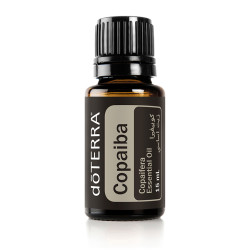
Copaifera officinalis, coriacea, reticulata & langsdorffii — 15ml · Steam distilled from the resinCopaiba is the oil most often confused with something it is not, so the clarification comes first: it contains no CBD, no THC and nothing derived from the cannabis plant, and it is not psychoactive. What it does contain, in unusually high proportion, is β-caryophyllene — a sesquiterpene found in many plants, including black pepper and cloves, which has a documented affinity for the CB2 receptor. That receptor is part of the body's own endocannabinoid system and is associated with inflammatory signalling rather than with the psychoactive effects mediated by CB1, which β-caryophyllene does not act on. It is a genuinely interesting mechanism, it explains why the oil has attracted serious research attention, and the human clinical evidence remains limited — so the accurate framing is a promising constituent rather than an established treatment. In the context of this article, it is the sensible choice where peppermint is not: warm, woody, faintly peppery, with no menthol and therefore no risk of loosening the valve that reflux depends on. Diluted over the abdomen or the lower back after a heavy meal, it is comfort rather than therapy — and unlike most oils here it is gentle enough on skin to be used regularly, which is part of why it has become one of the range's most popular bottles.
- ◆The choice instead of Peppermint when reflux is the pattern
- ◆Diluted over the abdomen or lower back, in a slow massage
- ◆Layers well under ZenGest for a fuller, warmer blend
- ◆Gentle enough on skin for regular use, diluted
- ◆No CBD, no THC, no psychoactive effect — a different plant entirely
Use with care: None of these products diagnoses, prevents or treats any digestive condition, and none replaces medical assessment or prescribed medication. Persistent reflux in particular should be assessed rather than managed indefinitely at home. Dilute all of these in Fractionated Coconut Oil for abdominal use and patch test on the inner forearm first. ZenGest contains fennel and anise and should be avoided in pregnancy without medical advice; it is also not suitable for young children's abdomens without paediatric guidance. Peppermint contains menthol, which can relax the oesophageal valve and worsen reflux, and must be kept away from the face and nostrils of children under six. Lemon is cold pressed and phototoxic — avoid direct sun for around twelve hours on any skin it touches, and never store it diluted in plastic. For any use other than aromatic or diluted topical, follow the product label and the regulations that apply where you live; internal-use labelling differs between markets and is not a decision to take from an article. Anyone pregnant, breastfeeding, taking regular medication, or managing a diagnosed condition should speak to their doctor before regular use.
Four routines, in the order they are worth your effort
The realistic lever: nobody here is going to finish eating at seven, so work on size rather than hour. Eat something substantial in the afternoon and the late plate becomes smaller by itself, which is far easier than trying to restrain yourself at eleven. Composition: the very fatty, very large plate is the one that sits; protein and vegetables move on faster. The gap: two to three hours upright before lying flat is the single most reliable change available — and the walk that a late dinner in a warm evening makes pleasant is part of it. After the meal: ZenGest diluted over the abdomen, sitting up, as a deliberate five-minute pause.
Water, deliberately: an air-conditioned office hides a continuous fluid loss, so thirst is a poor guide — keep a bottle on the desk and drink through the day rather than in two large amounts. Fibre, gradually: raise it over two or three weeks, with water, because a sudden increase produces exactly the bloating it was meant to fix. Two vegetable-heavy home-cooked meals in a restaurant week does most of the work. Movement: a daily walk affects transit more than most people expect; indoors in summer is fine. Routine: the bowel likes consistency — a regular morning, unhurried, matters more than any product.
The dilution: two drops of oil in a teaspoon of carrier — more than that is not more effective, only more likely to irritate. The direction: clockwise as you look down at your own abdomen, which follows the course of the colon; slow, with a flat palm, for three to five minutes. Which oil for which pattern: ZenGest for fullness after a heavy meal, Copaiba where reflux is the problem and menthol would make it worse, Peppermint for queasiness but not for reflux. What it is: comfort and a pause after eating, which is a modest and real thing — not treatment.
The honest hierarchy: meal timing, fibre, water, movement and sleep account for the overwhelming majority of digestive comfort, and no bottle changes that ranking. Keep a short record: three lines a day for two weeks — what, when, and how you felt — beats guessing, and beats eliminating whole food groups on suspicion. And note: eliminating foods without a diagnosis narrows a diet for no benefit; if you suspect an intolerance, get it looked at properly.
Five things worth getting right
-
01The gap before lying down beats everything else
If you change one thing after reading this, make it the two to three hours between the last substantial food and lying flat. It is free, it requires no product, and it addresses the mechanism directly rather than the sensation — a stomach that has largely emptied cannot push against a valve that has lost gravity's help. On a schedule where dinner arrives at eleven this is genuinely inconvenient, which is precisely why the earlier afternoon meal matters: it is what makes the late plate small enough for the gap to be achievable.
-
02Size and composition, not the clock alone
Advice to eat early is unusable here and therefore useless. What is usable is shifting the weight of the day earlier so the late meal is lighter, and choosing the version of it that empties faster — protein and vegetables rather than the fattiest plate on the menu. This is not a diet, and it is not about eating less over a day; it is about where in the day the largest load sits. People who make this one adjustment often report that both their digestion and their sleep improve, which is not a coincidence.
-
03Know which pattern you have before choosing an oil
This is where most money is wasted. Peppermint for reflux can make it worse, because menthol relaxes the valve involved. ZenGest is aimed at post-meal fullness rather than at slow transit. Nothing here addresses the fluid and fibre problem that causes most new arrivals' constipation. The four patterns set out earlier in this article are not decoration — they are the reason one person finds an oil transformative and another finds the same bottle useless, and matching the two is most of the skill.
-
04Dilute properly, and respect the specific cautions
Two drops in a teaspoon of carrier oil, patch tested first. More is not better on skin that thin. The cautions in this article are real rather than legal boilerplate: fennel and anise in ZenGest mean avoiding it in pregnancy without advice; menthol means peppermint away from young children's faces and away from reflux; cold-pressed lemon means no sun on treated skin for twelve hours, which matters a great deal in this climate. And for anything beyond aromatic or diluted topical use, the product label and your local regulation decide, not a blog.
-
05Two weeks of notes beats six months of guessing
Digestive symptoms are noisy: they vary with sleep, stress, travel and the weather, which makes single-meal conclusions almost always wrong. Three lines a day for a fortnight — what you ate, when, and how you felt afterwards — reveals patterns that no amount of reflection does, and it is also the single most useful thing you can bring to a doctor's appointment. It protects you from the other failure mode too, which is eliminating bread, dairy and half the vegetable aisle on suspicion and ending up with a narrow diet and the same symptoms.
The questions this subject usually raises
Can I put a drop of Lemon or Peppermint in my water?
The answer depends on where you are and what is on the bottle, which is why we will not give you a blanket yes. Labelling for internal use differs substantially between markets — doTERRA's own guidance is not identical in every country, and local food and supplement regulation decides what a product may be sold for. So: follow the product label and the rules that apply where you live, and if you are taking medication, are pregnant, or have any digestive diagnosis, ask your doctor rather than an article. Two practical points regardless. Never in a plastic bottle, because limonene degrades plastic and you will end up drinking some of it. And nothing about good digestion requires oil in water — it is a preference, not a protocol.
Does peppermint oil really help IBS?
There is reasonable clinical evidence, and it is about a specific product that is not the bottle on your shelf. The trials use standardised enteric-coated capsules — coated so they survive the stomach and release the oil further down, at a controlled dose, taken under medical supervision. That is a pharmaceutical preparation, and its results do not transfer to drops taken from a bottle or rubbed on the skin, which reach a completely different place at a completely different concentration. If you have IBS, this is a conversation to have with your doctor, who can advise on those capsules alongside the dietary approaches that have the strongest support. Using the bottle diluted on the abdomen for comfort is fine; presenting it as the studied treatment is not.
Why have I been constipated since I moved here?
Almost always a combination of four ordinary things, and it is one of the most fixable complaints in this article. Fluid loss in a hot climate is continuous and largely invisible, and a body short of water reabsorbs more of it from the colon. A restaurant-heavy few weeks delivers far less fibre than home cooking. Long flights and a new routine disrupt the regularity the bowel prefers. And in summer, daily movement often stops almost entirely. Address them in that order — water through the day, fibre raised gradually with water, a daily walk even if indoors, and an unhurried consistent morning. If it persists beyond a few weeks of genuinely doing those things, or comes with pain, bleeding or weight loss, see a doctor.
Is Copaiba the same thing as CBD?
No, and the distinction is worth being exact about. Copaiba is distilled from the resin of South American Copaifera trees and has no botanical relationship to cannabis whatsoever. It contains no CBD, no THC and no cannabinoids of the kind found in that plant, and it has no psychoactive effect. The reason the two get mentioned together is β-caryophyllene, a sesquiterpene abundant in copaiba and present in many everyday plants such as black pepper and cloves, which happens to bind the CB2 receptor of the body's own endocannabinoid system. CB2 is associated with inflammatory signalling; the psychoactive effects of cannabis are mediated by CB1, which β-caryophyllene does not act on. An interesting mechanism, limited human evidence, and an entirely different product.
When is bloating something to see a doctor about?
When it is new and persistent rather than occasional, when it is getting worse rather than fluctuating, or when it arrives with any of the following: unintended weight loss, blood in the stool or black stools, difficulty or pain on swallowing, persistent vomiting, pain that wakes you at night, unexplained anaemia, or a persistent change in bowel habit lasting more than a few weeks. Age matters too — new digestive symptoms appearing for the first time later in life warrant assessment rather than self-management. None of this is a reason for alarm about ordinary bloating after a large meal, which is common and benign. It is a reason not to spend six months on oils and elimination diets when a straightforward appointment would settle the question.
Unintended weight loss, blood in the stool or black stools, difficulty or pain on swallowing, persistent vomiting, abdominal pain that wakes you from sleep, unexplained anaemia, a persistent change in bowel habit lasting more than a few weeks, or new digestive symptoms appearing for the first time later in life should be assessed by a doctor rather than managed at home. The same applies to reflux that needs treating most days, to any symptom that is progressively worsening, and to anyone with a family history of bowel or stomach cancer or an existing gastrointestinal diagnosis. Nothing in this guide diagnoses, prevents or treats any condition; it describes ordinary digestive physiology, the effect of a late-dining schedule on it, and the limited roles aromatic products can honestly play alongside sensible changes to timing, fluid and fibre. Nothing here should delay an assessment that is warranted.
Same meal.
Different hour.
Different evening.
Take the free myTERRA Wellness Index assessment and find out which of the five pillars is carrying the load right now — immunity, digestion, energy and recovery, sleep and stress, or emotional balance — with a protocol built for that pattern rather than the average one.
Free Wellness Index assessment · Authentic doTERRA CPTG products · Delivery across the UAE
Related Products